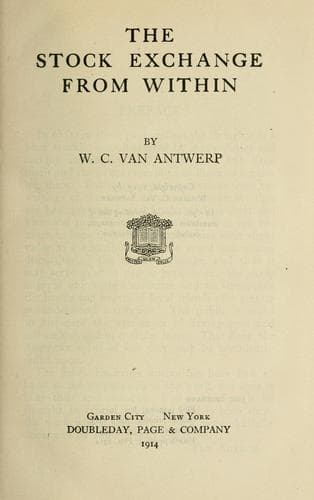
The Stock Exchange from WithinVan Antwerp, William C. (William Clarkson)
History
The Stock Exchange from Within
Van Antwerp, William C. (William Clarkson)
New York Stock Exchange; Stock exchanges
The halcyon days of these enterprises are now drawing to a close. Their
field of operations is becoming more and more limited, the postal
authorities are redoubling their energies, the newspapers are closing
their advertising columns, and the victims who have birthdays every
minute are, it is hoped, growing wiser. In any case immense losses
have been incurred, and immense harm done. To appreciate the extent of
it, one has but to look over the circle of one’s own acquaintances,
and count the worthless specimens of the engraver’s art that have
found a resting-place--permanently, I fear--in homes ill-prepared to
house them. Each one of these chromos has left its sting--each one has
excited a bitterness and resentment that, in the misdirected anger of
losers who will not see their own folly, is too often flung at Wall
Street and at the Stock Exchange.
The bucket-shop method is better known and easier to detect--hence it
is rapidly being exterminated. “Bucketing,” as it is called, usually
flourishes in small towns at a considerable distance from New York.
Formerly it thrived in the larger cities, even those adjacent to the
Metropolis, but it has now been driven from these places. It professes
to trade in stocks for its customers, and its office windows are
usually decorated with signs that indicate, though they do not always
say so plainly, that the house is identified with “the Stock Exchange.”
It allows its customers to trade on what is called “a two-point
margin,” that is to say, the buyer or seller is “wiped out” when the
market has fluctuated two points against the price at which the trade
is made. The word of the house must be accepted for the veracity of its
prices, which, however, are supplied to it by telegraph from New York.
Bear in mind that these prices are not telegraphed to the customer,
but to the mysterious persons in the rear office of the shop. They
call themselves brokers--this bucket-shop fraternity--but they are not
brokers in any sense by which that elastic term is used. They have not
even the “redeeming vices” of gamblers; they are swindlers.
The trader in such a place starts with all the odds in favor of the
house. To be exact he pays two commissions and the market “turn” is
against him _ab initio_. If the stock is 100 bid, 100¼ asked, he buys
at 100¼ always. If he sells at the same quotation, he sells at 100. He
could not sell in the former case at 100¼, nor buy in the latter case
at 100, so he starts ¼ per cent. “to the bad.” If, then, he bought
at 100¼, when the price is 98¼–½, his two-point margin is exhausted,
although the price has actually declined only 1¾ per cent. Thus he is
required to bet heavy odds on what is really no better than an even
money chance, even allowing that the prices are honest.
Public-domain text, read in full here on John Shaqi.
Reviews
Reviews
No reviews yet
Be the first to share your thoughts on this work.
Join the Discussion
Join the discussion
Sign in to leave a comment or review.
Sign InorCreate an account