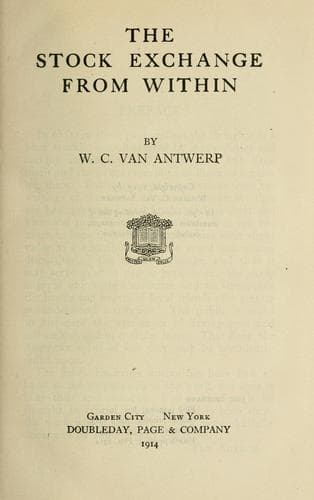
The Stock Exchange from WithinVan Antwerp, William C. (William Clarkson)
History
The Stock Exchange from Within
Van Antwerp, William C. (William Clarkson)
New York Stock Exchange; Stock exchanges
In the very nature of things the development of each part of this
gradually devised machinery has been attended by mistakes, by errors
of judgment, and by occasional wrongdoing, yet we do not condemn the
national banking system because there were once wildcat banks; we do
not utter hasty judgments on stock-companies because in other days they
were badly organized and incompetently managed; we do not withhold
our support from railways because they once erred by pushing too
ambitiously into projects that ruined innocent stockholders; we do not
abandon our form of government because there was once civil war. No,
but we try to keep all these things in view in order to profit by them,
and to see to it that they do not happen again. We say of individuals
that no man’s vices are sufficient reasons for not admiring his
virtues. Why not apply the same code to business?
One of the mistakes of members of the Stock Exchange in the past has
been in trying to do too much business on too little capital. This is
a subject that calls for plain speaking, since it directly caused two
Stock Exchange failures in recent years, failures that were, I am sorry
to say, essentially the result of dishonesty. Every Stock Exchange
house is looking for business, and a house with small capital sometimes
gets more than it should attempt to handle. Such a house borrows from
the bank, as all houses do, and allows its bankers a 20 per cent.
margin; so far so good. But it accepts business from its customers on a
10 per cent. margin, and this means financing the difference out of the
firm’s capital. If the capital is large, the business is safe, but if
it is small, the house finds itself “loaded up,” as the phrase is, and
is then in such a predicament that it must either summon enough moral
courage to refuse business altogether and so advertise its limitations,
or abandon its moral courage, sell its customer’s stocks “short” and
incur the risk of buying them back cheaper.
The latter course is dishonest; it is in fact nothing more or less than
a form of “bucketing,” since the customer must lose for the broker to
save himself, while, if the customer wins, the broker may not be able
to pay. This is not a common practice of course--first, because 99
per cent. of the members are absolutely honest; second, because the
majority of those who carry accounts on the books of Stock Exchange
houses are wise enough to acquaint themselves with the firm’s resources
and to withdraw when too much business becomes apparent, and, third,
even though a broker were not himself essentially honest, he would
not dare expose himself to the expulsion and disgrace that would
attend exposure. Nevertheless, the thing has been done, and it may
conceivably occur again. How then may it be avoided?
Public-domain text, read in full here on John Shaqi.
Reviews
Reviews
No reviews yet
Be the first to share your thoughts on this work.
Join the Discussion
Join the discussion
Sign in to leave a comment or review.
Sign InorCreate an account