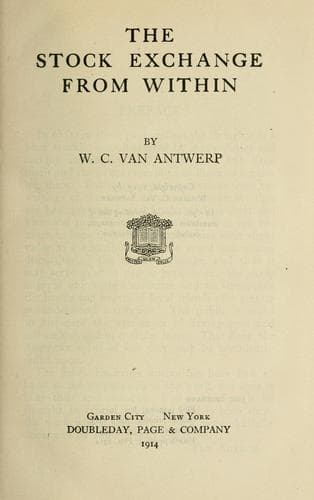
The Stock Exchange from WithinVan Antwerp, William C. (William Clarkson)
History
The Stock Exchange from Within
Van Antwerp, William C. (William Clarkson)
New York Stock Exchange; Stock exchanges
The time has passed to sit supinely under every sinister attack and
imagine that a consciousness of rectitude will suffice as an answer.
Let the Exchange bestir itself. If, as happened very recently, a judge
on the bench can so lose his poise as to say to a common thief at the
bar, “You have committed a petty theft and you must go to jail--but
had you gone down to the Stock Exchange and stolen a million you would
go free”--such an unworthy utterance should be handled promptly and
without gloves by the Exchange authorities, and the same course of
treatment should be applied vigorously to every thoughtless minister
of the gospel and every cheap politician who, because the Exchange
has so long remained silent, may think that such silence entitles him
to utter any libel that comes to mind. The newspaper that publishes
the original utterance of this judge or that preacher will publish
also the steps taken by the Exchange to bring him to book, and even
though the slanderer may escape the consequences of his act through
the technicalities of the law, or otherwise, the knowledge that the
Exchange is at last aroused from its lethargy and in a fighting mood
will serve to deter others from similar indiscretions. I violate no
confidence when I say that henceforth the Stock Exchange will be found
defending itself manfully, and I venture to remind all noisy seekers
of notoriety that “thrice is he armed who hath his quarrel just.”
The Stock Exchange has felt, since the report of the Hughes Commission
in 1909, that such a report, by such a body of men, would inevitably
stay the hand of many of its detractors by showing them just what
the Exchange is trying to do, and just how the work is done. “The
committee,” says its chairman, “was in session about six months. Its
expenses were paid by the members themselves, and since frugality was
a necessity the services of the stenographers were dispensed with, the
members taking only such notes of the testimony of witnesses as each
one deemed important to the matter in hand. The officers of all the
Exchanges in New York City were invited to appear before the committee
and answer questions both orally and in writing, and all of them
responded promptly and courteously, as often as they were asked to do
so. Many volunteer witnesses, citizens of the State, were heard. None
such was refused a hearing. Citizens of other States were not called,
or accepted, as witnesses unless they had given evidence, by published
writings or otherwise, that they had something of value to contribute
to the discussion.”[50] This committee was composed of Horace White,
Chairman; Charles A. Schieren, David Leventritt, Clark Williams, John
B. Clark, Willard V. King, Samuel H. Ordway, Edward D. Page, Charles
Sprague Smith, Maurice L. Muhleman.
Public-domain text, read in full here on John Shaqi.
Reviews
Reviews
No reviews yet
Be the first to share your thoughts on this work.
Elsewhere in the archive
Join the Discussion
Join the discussion
Sign in to leave a comment or review.
Sign InorCreate an account