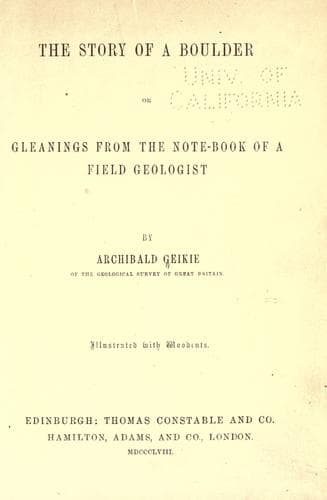
The Story of a Boulder; or, Gleanings from the Note-book of a Field GeologistGeikie, Archibald
Science
The Story of a Boulder; or, Gleanings from the Note-book of a Field Geologist
Geikie, Archibald
Geology; Petrology
In fine, from all the genera and species of plants that have been
detected in the strata of the coal-measures, it would appear that the
flora of that ancient period was in a high degree _acrogenous_--that
is to say, consisted in great measure of ferns, club-mosses, and other
members of the great group of plants known as _acrogens_. This word
literally means _top-growers_, and is applied to those plants which
increase in height, but not in width, since they attain at first
nearly their ultimate diameter. Such plants occupy a low position in
the botanical scale. Mingled with the numerous genera of carboniferous
ferns and club-mosses, we find the remains of a much higher grade
of vegetation--that of the _gymnogens_, or plants that bear naked
seeds--such as the firs and pines. There also seem to have been a
few _endogenous_ flowering plants. Viewing, then, this flora on the
whole, it presents us with many striking resemblances to certain
botanical regions of the present day. Many of the tropical islands
abound in ferns, and contain very few flowering plants. But New Zealand
affords perhaps the closest parallel. That island is in certain parts
highly mountainous, its loftiest summits being covered with glaciers.
The hills throughout large districts are bare, or covered with a
scanty herbage, while in other localities they are densely clothed
with forests of pine, beech, and other trees. These forests sweep
on to the lower grounds, where they are replaced by a thick growth
of fern and flax-plant intermingled with dragon-trees and graceful
tree-ferns, while the more swampy regions support a rich profusion of
reeds and rushes. Such a condition of things affords a close parallel
to the probable vegetation of the Carboniferous period--an immense
preponderance of ferns and arborescent acrogens, with an intermixture
of large coniferous trees. From the general scantiness of a flora
where ferns predominate, it has been argued that the swamps of the
coal-measures nourished a luxuriant repetition of comparatively few
species; and this hypothesis also receives confirmation from the
vegetation of New Zealand. Another deduction founded on the resemblance
of the ancient to the modern flora, refers to the conditions of heat
and moisture. It has been inferred that the climate of the coal period
was equable and humid, like that of New Zealand--a supposition much
more natural and simple than that, once so much in vogue, of a heated
atmosphere densely charged with carbonic acid gas. That the air of the
Carboniferous period differed in no material respect from the air of
the present day, seems at last proved by the remains of air-breathing
animals having been found among the coal-beds; and there seems no
reason why the higher mountain-tops of the same epoch may not have been
clothed with glaciers as those of New Zealand are. As yet we have no
evidence of the fact, but it is by no means beyond the possibility of
proof.[29]
Public-domain text, read in full here on John Shaqi.
Reviews
Reviews
No reviews yet
Be the first to share your thoughts on this work.
Join the Discussion
Join the discussion
Sign in to leave a comment or review.
Sign InorCreate an account