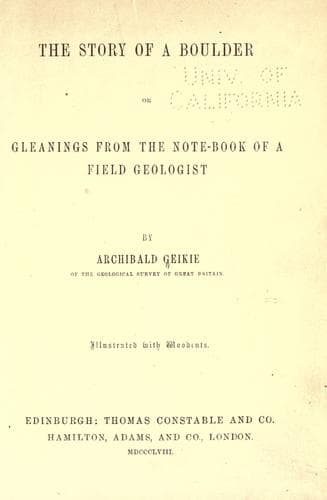
The Story of a Boulder; or, Gleanings from the Note-book of a Field GeologistGeikie, Archibald
Science
The Story of a Boulder; or, Gleanings from the Note-book of a Field Geologist
Geikie, Archibald
Geology; Petrology
Thickets of tall reeds rose out of the water, with stems massive as
those of our forest-trees, encircled at regular distances by wreaths of
pointed leaflets, and bearing on their summits club-like catkins. Far
away, the distant hills lay shaggy with pine-woods, and nursed in their
solitudes the springs and rivulets that worked a devious course through
forest, and glen, and valley, until, united into one broad river, they
crept through the rich foliage of the delta and finally passed away out
to sea, bearing with them a varied burden of drift-wood, pine-trees
from the hills, and stray leaves and cones from the lower grounds.
How different such a scene from that now presented by the very same
areas of country! These old delta lands are now our coal-fields, and
have exchanged the deep stillness of primeval nature for the din and
turmoil of modern mining districts. In these ancient times, not only
was man uncreated, but the earth as yet lacked all the higher types of
vertebrated being. None of the animals that we see around us existed
then; there were no sheep, nor oxen, horses, deer, nor dogs. Neither
were the quadrupeds of other lands represented; the forests nourished
no lions or tigers, no wolves or bears, no opossums or kangaroos. In
truth, the land must have been a very silent one, for we know as yet of
no animated existence that could break the stillness, save perchance
some chirping grasshopper, or droning beetle, or quivering dragon-fly.
No bee hummed along on errands of industry; it is doubtful, indeed,
whether honey-yielding flowers formed part of the carboniferous flora;
no lark carolled blithely in the sky, nor rook croaked among the
woods. All was still; and one might, perhaps, have stood on some of
those tree-crested islets, and heard no sound but the rippling of the
water along the reedy and sedgy banks, and the rustling of the gloomy
branches overhead.
To one who muses on these bygone ages it is no unimpressive situation
to stand in the midst of a large coal district and mark its smoking
chimneys, clanking engines, and screaming locomotives, its squalid
villages and still more squalid inhabitants, and its mingled air of
commercial activity, physical wretchedness, and moral degradation.
It is from such a point of view that we receive the most forcible
illustration of those great changes whereof every country has been the
scene, and which are so tersely expressed by one who has gazed on the
revelations of geology with the eye of a true poet--
"There rolls the deep where grew the tree.
O earth, what changes hast thou seen!
There where the long street roars, bath been
The stillness of the central sea."
Public-domain text, read in full here on John Shaqi.
Reviews
Reviews
No reviews yet
Be the first to share your thoughts on this work.
Join the Discussion
Join the discussion
Sign in to leave a comment or review.
Sign InorCreate an account