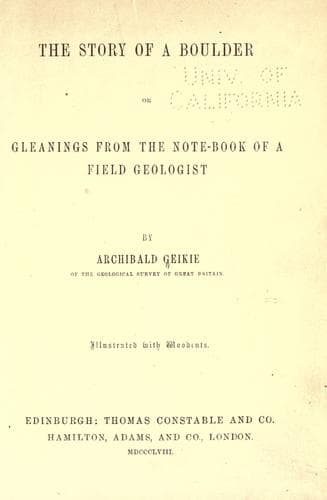
The Story of a Boulder; or, Gleanings from the Note-book of a Field GeologistGeikie, Archibald
Science
The Story of a Boulder; or, Gleanings from the Note-book of a Field Geologist
Geikie, Archibald
Geology; Petrology
The study of fossil animals embraces a much greater range of subject
than that of fossil plants. The _fauna_ of any particular geological
formation, that is to say, its embedded animal remains, for the most
part vastly exceeds in number its _flora_, or vegetable remains, and is
likewise usually better preserved. About the nature and affinities of
several tribes of fossil plants there hangs an amount of uncertainty
which renders them a dubious guide to the climatal and other conditions
of the period and locality in which they lived. Generic distinctions
among living plants often rest on the character of those parts which
are the most perishable, such as flowers and seed-vessels. These
delicate structures we, of course, can hardly look to find preserved
in the rocks, and we have in place of them only detached leaflets,
twigs, branches, and stems, often sorely mutilated in outward form, and
presenting no trace of internal organization. But the tribes of the
animal kingdom have, for the most part, harder frameworks. The minute
infusoria, which by their accumulated remains help to choke up the
delta of the Nile, and swarm by millions in every ocean of the globe,
have their silicious or calcareous shells so minute that Ehrenberg
has estimated a cubic inch of tripoli to contain forty-one thousand
millions of them. The polypi have their internal calcareous skeletons,
which abound in all the older limestones, and form the coral reefs of
the present day. The mollusca, too, though, as their name imports, they
have perishable bodies, are yet, in most cases, furnished with hard
calcareous shells, that indicate by their various modifications of form
and structure, the character of the animal that lived within them. They
are found in all the formations from the earliest upwards, and as they
vastly exceed in numbers all the other classes with which the geologist
has to deal, they form the larger part of that basis of evidence from
which he interprets the past history of organized existence. Hugh
Miller loved to talk of them as the "shell alphabet," out of which the
language of palæontological history should be compiled. The vertebrata,
too, all have their hard skeletons, easily capable of preservation,
whether it be in the form of the massive exo-skeleton of bone that
characterized the older ganoidal fishes, or the compact endo-skeleton
of the reptiles and mammals. A greater amount of attention is,
therefore, due to the study of fossil animals, since they thus not
only far exceed fossil plants in number, but possess a higher value as
evidence of ancient physical conditions.
Public-domain text, read in full here on John Shaqi.
Reviews
Reviews
No reviews yet
Be the first to share your thoughts on this work.
Join the Discussion
Join the discussion
Sign in to leave a comment or review.
Sign InorCreate an account