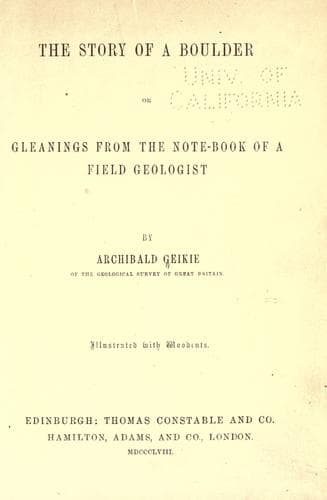
The Story of a Boulder; or, Gleanings from the Note-book of a Field GeologistGeikie, Archibald
Science
The Story of a Boulder; or, Gleanings from the Note-book of a Field Geologist
Geikie, Archibald
Geology; Petrology
Despite all the improvements and inventions of modern times, classic
architecture has made no progress since the days of Pericles. All that
we do now is but to reproduce what the Greeks created 2000 years ago,
and he is reckoned the best architect who furnishes the best imitation.
Our architects might find some useful hints, however, by studying the
lowlier orders of nature. They would see there patterns of beauty far
more delicate than the Grecian capital, and more light and airy than
the Gothic shaft. And whether or not they could found a new order of
architecture, they could not fail to discover many modifications and
improvements upon some of the old. They could not readily light upon
a more graceful form than that of the lithostrotion, would they but
picture it as it grew at the bottom of the old carboniferous sea. A
group of hexagonal pillars, firmly compacted together like those of
the Giant's Causeway, or Fingal's Cave, rose from a white calcareous
pediment, as columns from the marble steps of an Athenian temple. Each
side of the pillar had a wavy undulating surface, delicately fluted by
long slender striæ, the whole being so arranged that the convexities
of one surface fitted into the sinuosities of the adhering one. Each
pillar was crowned above by a capital, consisting of the soft vibratile
tentacles of the animal, that hung over like so many acanthus leaves.
Of the form of these tentacles, their design and grouping, we know
nothing save what may be gathered from the analogy of living corals.
There can be little doubt, however, that, like the flower-shaped buds
of the existing reef-building polyps, they must have been eminently
beautiful, and in strict keeping with the graceful column which they
crowned.
Another kindred form was that known as the _lithodendron_. It, too,
grew in colonies, and seems to have closely resembled the last, save
that the pillars, in place of being six-sided, were round. I have seen
a bed of these corals several yards in extent, and seven or eight
inches deep, where the individuals were closely crowded together, so
as to resemble a series of tobacco-pipe stems, or slim pencils set on
end. The tubes, however, were not all quite straight; many being more
or less curved, and sometimes crossing their neighbours obliquely.
The internal arrangement was on the same plan as in the two previous
corals. The same numerous partitions ran from the exterior wall
towards the central tube, the same thick-set diaphragms crossed the
entire breadth of the column, imparting the same minute honey-combed
appearance to a cross section. The exterior of the column (in _L.
fasciculatum_) was likewise traversed by the same longitudinal striæ.
Public-domain text, read in full here on John Shaqi.
Reviews
Reviews
No reviews yet
Be the first to share your thoughts on this work.
Elsewhere in the archive
Join the Discussion
Join the discussion
Sign in to leave a comment or review.
Sign InorCreate an account