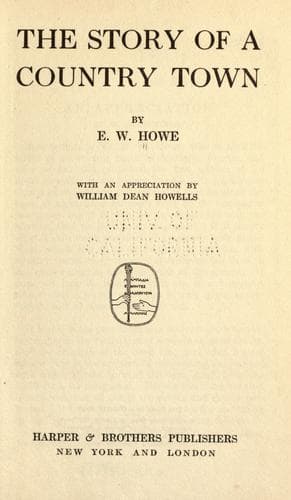
The Story of a Country TownHowe, E. W. (Edgar Watson)
General
The Story of a Country Town
Howe, E. W. (Edgar Watson)
Frontier and pioneer life -- Kansas -- Fiction
That she was a miserable housekeeper I had frequent occasion to know,
and Barker’s house always seemed like a bachelor’s home, as there was
nothing about it to indicate that a woman lived there. Jo used to say of
Mrs. Tremaine that she talked as the women write who furnish recipes to
the newspapers; and when she came to our house the room in which she sat
seemed damp for several days thereafter. Once after she had slept there,
and I was put into the bed she had occupied a night or two afterward, I
amused my mother by asking her to change the sheets, as they seemed like
ice and would not thaw out, and the good humor with which she did this
convinced me that she did not like B. very well herself. Her face was
large and round and of a waxen color, and though it was said by some
that she was handsome I never thought so; nor did I admire her dress,
which was very rich and expensive, though exceedingly plain. Her teeth
were very white, and quite prominent, because she always wore what was
intended to be an enchanting smile, and when she kissed me (which she
usually did in the earlier days of our acquaintance, as a compliment to
a child) I thought she must have just finished washing her face, her
lips were so cold and damp. Her hair being very dark, and her face very
pale, I thought she resembled a well-dressed and affable corpse risen
from the dead, whose business it was to go among the people and warn
them that unless they repented of their sins they would very much regret
it after death.
CHAPTER VII.
A NEW DISPENSATION.
In spite of the discontent which prevailed there, Fairview progressed
with the years of its history. The hard work of the people paid, and
they gradually became well-to-do, although they seemed surprised that
they were not in the poor-house, an event they were always promising
their families.
The old houses in which they had at first lived were replaced with new
ones, the new ones were furnished better than the old ones had been, and
there was a general prosperity which surprised them, for they had not
expected it so soon, if at all. New people came to settle in spite of
the fact that they were neither invited nor expected, and many of those
who came first had money ahead, and were regarded by those who came
later as of a very old and aristocratic stock. Strangest of all, it was
announced that a new minister had been engaged, and that he would arrive
with his family, consisting of a wife and one child, in a few days. My
father made the announcement at the close of his preaching one spring
morning. He had preached to them, he said, because they were too poor to
pay a better man; the Lord had prospered them, and he cheerfully made
way for a successor who had not only religious enthusiasm, but extensive
learning as well. He would continue to exhort his brethren whenever
occasion seemed to require, and aid in doing the work of the Master,
but he believed the good of the church demanded the arrangement he had
made.
Public-domain text, read in full here on John Shaqi.
Reviews
Reviews
No reviews yet
Be the first to share your thoughts on this work.
Join the Discussion
Join the discussion
Sign in to leave a comment or review.
Sign InorCreate an account