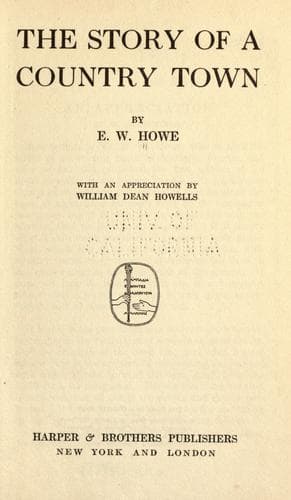
The Story of a Country TownHowe, E. W. (Edgar Watson)
General
The Story of a Country Town
Howe, E. W. (Edgar Watson)
Frontier and pioneer life -- Kansas -- Fiction
I knew nothing of the settlement except the direction, which was north,
and that the uncle with whom Agnes lived was named Biggs, but they said
I could easily inquire the way. The distance was twenty miles, and by
repeated inquiries I found that Mr. Biggs--who was called Little Biggs
by those living near him--lived in the first white house after crossing
the north fork of Bull River, and when I came in sight of the place I
knew it as well as if I had lived within hailing distance all my life.
It was just such a place as I expected to find; an aristocratic porch on
two sides of a house evidently built after the plans of an
architect--the first house of such pretensions I had ever seen--with a
gravel walk leading down to the gate, and a wide and neglected yard in
front. A broken and dismantled wind-mill stood in the barn-yard, and
around it was piled a great collection of farm machinery in an equally
advanced stage of decay, all rotting away for lack of care and use.
There was a general air of neglect everywhere, and I thought Mr. Biggs
was an indifferent farmer, or else an invalid. Boards were off the
fences, and gates off the hinges, and pigs roamed in every place where
they did not belong. A herd of them, attracted by the sound of my
wheels, dashed out from under the porch, and went snorting into the
vegetable garden through a broken fence. I noticed these things as I
stopped at a large gate intended for wagons to drive through, and while
wondering whether I had better drive in there, or tie the team and walk
up to the house. While debating the question I saw that a large,
boyish-looking young man was pitching hay near the barn, and, noticing
that he had stopped his work and was looking at me, I motioned for him
to come out. Impatiently throwing down his fork, he came out to the
fence, and, resting his chin on the top board, he looked at me with
great impudence.
“Does Mr. Biggs live here?” I civilly inquired.
“Yes, Mr. Biggs lives here,” he answered, drawling the first word as if
to express disgust.
“Well, then,” I said, “if you will open the gate I’ll come in.”
He threw it open with a bang, as if to express an unfavorable opinion of
me, and I drove through, and stopped down by the stables. He followed
sullenly, after banging the gate again, and, picking up his fork without
looking at me, went on with his pitching. I began to feel uncomfortable
at this cool reception, and inquired quite respectfully:--
“Is Mr. Biggs at home?”
“No,” the fellow replied, “he’s not at home,” plunging his fork
viciously into the hay as though he were wishing I was under it.
“Is Miss Agnes at home, then?”
“Yes, Miss Agnes is at home.” He looked up in better humor, as though
the name of Agnes was not so disagreeable as that of Biggs.
“Well, I’m told to stay here to-night, and take Agnes to her school
to-morrow. If you’ll show me where to stand the horses I’ll put them
away.”
Public-domain text, read in full here on John Shaqi.
Reviews
Reviews
No reviews yet
Be the first to share your thoughts on this work.
Elsewhere in the archive
Join the Discussion
Join the discussion
Sign in to leave a comment or review.
Sign InorCreate an account