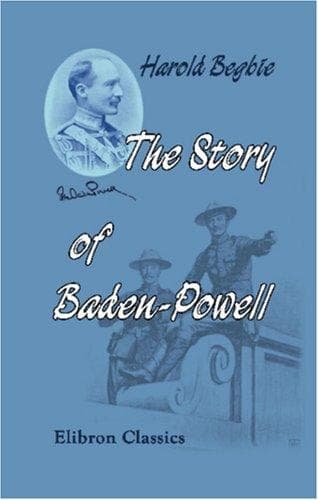
The Story of Baden-Powell: 'The Wolf That Never Sleeps'Begbie, Harold
History
The Story of Baden-Powell: 'The Wolf That Never Sleeps'
Begbie, Harold
Baden-Powell of Gilwell, Robert Stephenson Smyth Baden-Powell, Baron, 1857-1941
Buluwayo was the town selected by the Matabele for their first blow,
and accordingly with Sir Frederick Carrington and two other officers
B.-P. set out from Mafeking on the 23rd May in a ramshackle coach,
drawn by ten mules, on a drive of ten days and nights to Buluwayo. On
this journey the officers encountered the celebrated King Khama, and
it interested B.-P. to find that Khama knew him as the brother of Sir
George Baden-Powell, and that he inquired after Sir George's little
girl, just as a lady in the Park asks if one's baby has got over the
measles. This (if we leave out a dinner at a wayside "hotel," where
the waiter smoked as he served our officers) was the one picturesque
incident of that jolting, clattering drive of nearly 560 miles, and,
therefore, while our hero is groaning in the coach or travelling
afield after partridges and guinea-fowl for dinner, we will take leave
to look hastily for the reason of his presence in South Africa.
Matabeleland, let us say at the beginning, is included in Rhodesia, a
country 750,000 miles in extent, or, so that the size may jump to the
eye, let us say as big as France, Italy, and Spain lumped together.
This vast country was under the administration of the British
Government, but the Matabele, who had been but partially beaten in the
taking of their country in 1893, were only waiting their opportunity
to throw off the white man's yoke. The opportunity came when the
deplorable Jameson raid emptied the country of troops, and left our
brave hard-working colonists at the mercy of these savages. But there
were other causes contributory to the rebellion. Rinderpest was
slaying the cattle of the Matabele by thousands, and the white man's
order that, to prevent the scourge from spreading, healthy beasts as
well as diseased should be killed was, not unnaturally, quite
unintelligible to the Matabele. The rumour spread that the hated white
man was killing the cattle in order that the tribes should perish of
starvation. The fact, too, that raiding weaker tribes for food was
punished by the British further aggravated this "offence." The priests
encouraged the spirit of rebellion, and the oracle-deity, the M'limo,
promised through the priests that if the Matabele would make war upon
the white man his bullets in their flight should be changed to water,
and his cannon shells become eggs. Horrible murders followed upon this
encouragement, too horrible, indeed, to repeat; but a general idea of
the blood-lust which now possessed the Matabele may be gathered from
the fact of over a hundred and fifty English people (scattered, of
course, in outlying districts) being killed within a week of the
M'limo's call to battle. Only a swift blow, then, could prevent the
loss of civilisation to South Africa for many years; only a terrible
lesson could teach the Matabele that the white man was his lord and
master.
Public-domain text, read in full here on John Shaqi.
Reviews
Reviews
No reviews yet
Be the first to share your thoughts on this work.
Elsewhere in the archive
Join the Discussion
Join the discussion
Sign in to leave a comment or review.
Sign InorCreate an account