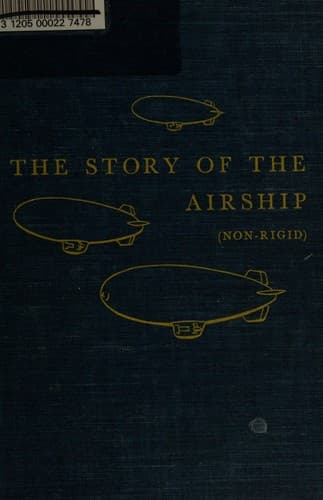
The Story of the Airship (Non-rigid): A Study of One of America's Lesser Known Defense WeaponsAllen, Hugh
History
The Story of the Airship (Non-rigid): A Study of One of America's Lesser Known Defense Weapons
Allen, Hugh
Military airships -- United States
England was using them, might ask this country to supply some. The
American government too might have use for them. So, long before there
was even any hint of orders, Mr. Litchfield threw a new problem to the
engineers at Goodyear Aircraft and the operating men at Wingfoot
Lake—the job of designing an efficient barrage balloon. They were not to
make Chinese copies of foreign balloons, but draw on their experience in
lighter-than-air and see if principles and technique established there
could not be applied to design balloons which would ride with maximum
stability in gusty and unstable air. Men went to work, designing,
building, flying, observing, rejecting, altering, improving, week after
week, month after month, until several satisfactory types were evolved.
One of these was capable of flying at 15,000 feet, twice the usual
height. Orders began to come in, and the little group of men and girls
in the balloon room quickly grew into a large organization. The
department outgrew its quarters, took over room after room, expanded to
subsidiary plants outside Akron.
One instrument developed illustrates how the airship men were able to
utilize past experience in a new project.
Mounted alongside the winch on the ground, it gave exact information, as
often as was wanted, as to what the barrage balloon was doing, a mile or
three miles up.
This assembly included a moving picture camera, which continuously, or
at fixed intervals, or at any instant desired, by means of radio
control, would photograph recording dials and show these things: wind
velocity at the balloon, tension on cable, gas pressure inside the
balloon, temperature of confined gas, temperature and humidity of the
air surrounding the balloon, angle of attack at which the balloon faced
the wind, both fore and aft and from side to side, also a clock, which
showed the time the readings were recorded.
These pictures, when developed gave the engineers the data from which
they could modify designs and arrive at a type of balloon which would
ride most easily aloft, avoid undue tugging and surging on the
cable—incidentally permitting smaller gauge and weight cable to be used
for a given height with ample safety margin.
Perhaps the largest single result, however, growing out of the fleet
operations was that it had created manufacturing facilities, ships and
personnel on which the Navy could draw, as fully as it wanted, in
emergency, and with little more delay than the time it took for a man to
change his uniform.
Boettner, Sewell, Blair, Hobensack and Hill followed the others into the
service. Hobensack’s ground crew in California signed up with him in a
body, and men from other ground crews, expert in rigging, in motors,
radio, in mooring out and maintenance joined up. In the end only Fickes
and Crum were left at Akron to build the new ships, and Sheppard,
Crosier and Massic to test-fly them, then ferry them to their
destinations.
Public-domain text, read in full here on John Shaqi.
Reviews
Reviews
No reviews yet
Be the first to share your thoughts on this work.
Elsewhere in the archive
Join the Discussion
Join the discussion
Sign in to leave a comment or review.
Sign InorCreate an account