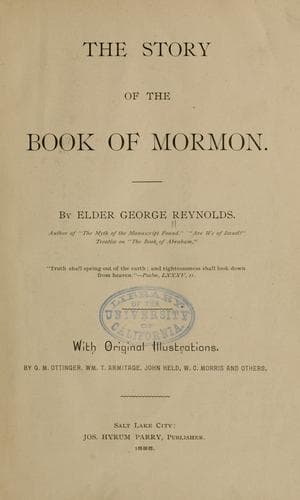
Book of Mormon; Latter Day Saint churches -- Doctrines; Latter Day Saints
Mosiah now felt that it was time that the question of the succession
to the throne should be settled. In his magnanimity he sent among
the people to learn whom they would have for their king. The people
chose his son Aaron, but Aaron would not accept the royal power; his
heart was set upon the conversion of his fellow-men to the truths of
the gospel. This refusal troubled the mind of Mosiah; he apprehended
difficulties if Aaron at some future time should change his mind and
demand his rights. Mosiah therefore issued another address to his
much-loved subjects, as usual full of the spirit of divine wisdom and
love. In it, after recounting the peculiarities of the situation, he
says: Let us be wise and consider these things, for we have no right to
destroy my son, neither should we have a right to destroy another, if
he should be appointed in his stead. And if my son should turn again
to his pride and vain things, he would recall the things which he had
said and claim his right to the kingdom, which would cause him and also
his people to commit much sin. * * * Therefore, I will be your king the
remainder of my days; nevertheless, let us appoint judges, to judge
this people according to our law, and we will newly arrange the affairs
of this people; for we will appoint wise men to be judges that will
judge this people according to the commandments of God.
Inspired and directed by the Lord, the king further advised many
changes of the law, so that all things might be done by the voice of
the whole people. These changes were gladly accepted by the people, as
they gave them greater liberty and a voice in all important national
affairs. As a law-maker Mosiah may be ranked among the most eminent
this world has produced. We regard him in some respects as the Moses,
in others as the Alfred the Great, of his age and nation. But besides
being a king he was also a seer. The gift of interpreting strange
tongues and languages was his. By this gift he translated from the
twenty-four plates of gold, found by the people of king Limhi, the
records of the Jaredites. No wonder that a man possessed of such gifts,
so just and merciful in the administration of the law, so perfect in
his private life, should be esteemed more than any man by his subjects,
and that they waxed strong in their love towards him. As a king, he
was a father to them, but as a prophet, seer and revelator he was the
source whence divine wisdom flowed unto them. We must go back to the
days of the antediluvian patriarchs to find the peers of these three
kings (the two Mosiahs and Benjamin), when monarchs ruled by right
divine, and men were prophets, priests and kings by virtue of heaven's
gifts and God's will.
Public-domain text, read in full here on John Shaqi.
Reviews
Reviews
No reviews yet
Be the first to share your thoughts on this work.
Join the Discussion
Join the discussion
Sign in to leave a comment or review.
Sign InorCreate an account