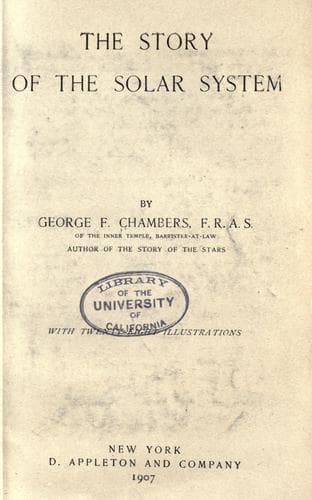
The Story of the Solar SystemChambers, George F. (George Frederick)
Science
The Story of the Solar System
Chambers, George F. (George Frederick)
Solar system
I have been thus particular in unfolding somewhat fully the present
state of our knowledge concerning the twinkling of the stars, because it
is evident that there are many interesting points connected with it,
which may be studied by any patient and attentive star-gazer, and which
do not need the instrumental appliances and technical refinements which
are only to be found in fully-equipped public and private observatories.
It should be mentioned in conclusion that the planets twinkle very
little, or, more often, not at all. This is mainly due to the fact that
they exhibit discs of sensible diameter and therefore that there is, as
Young puts it, “a general unchanging average of brightness for the sum
total of all the luminous points of which the disc is composed. When,
for instance, point A of the disc becomes dark for a moment, point B,
very near to it, is just as likely to become bright; the interference
conditions being different for the 2 points. The different points of the
disc _do not keep step_, so to speak, in their twinkling.” The
non-twinkling of planets because they possess sensible discs is often
available as a means for determining when a planet is looked for, which,
of several objects looked at, is the planet wanted and which are merely
stars.
CHAPTER VI.
THE MOON.
The Moon being merely the satellite of a planet, to wit, the Earth, it
should, according to the plan of this book, be included in the chapter
which deals with its primary; but for us inhabitants of the Earth the
Moon has so many special features of interest that it will be better to
give it a special chapter to itself.
Public-domain text, read in full here on John Shaqi.
Reviews
Reviews
No reviews yet
Be the first to share your thoughts on this work.
Join the Discussion
Join the discussion
Sign in to leave a comment or review.
Sign InorCreate an account