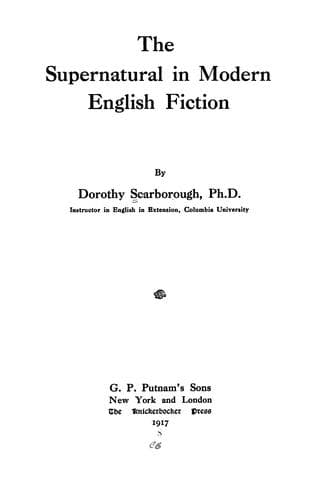
The Supernatural in Modern English FictionScarborough, Dorothy
History
The Supernatural in Modern English Fiction
Scarborough, Dorothy
English fiction -- History and criticism; Supernatural in literature
Other fields of thought have been opened to us within this generation
by the widening of our knowledge of the literature of other European
countries. Books are much more freely translated now than formerly
and no person need be ignorant of the fiction of other lands. From
the Spanish, the Portuguese, the Chinese, Japanese, and other tongues
we are receiving stories of supernaturalism that give us new ideas,
new points of view. The greater ease of travel, the opportunity to
study once-distant lands and literatures have been reflected in our
fiction. Some one should write a monograph on the literary influence of
Cook's tours! Our later work has a strong touch of the Oriental,--not
an entirely new thing, since we find it in Beckford's _Vathek_ and
the pre-Gothic tales of John Hawkesworth,--but more noticeable now.
Examples are Stevenson's _New Arabian Nights_, _Bottle Imp_, and
others, F. Marion Crawford's _Khaled_ and _Mr. Isaacs_, Blackwood's
stories of Elementals, George Meredith's fantasy, _The Shaving of
Shagpat_, though many others might be named. The Oriental fiction
permits the use of magic, sorcery, and various elements that seem out
of place in ordinary fiction. The popularity of Kipling's tales of
Indian native life and character illustrates our fondness for this
aspect of supernaturalism.
Apart from the foreign influences that affect it we notice a certain
change in the materials and methods of ghostly fiction in English. New
elements had entered into Gothic tales as an advance over the earlier
forms, yet conventions had grown up so that even such evasive and
elusive personalities as ghosts were hidebound by precedent. While
the decline of the _genre_ definitely known as the Gothic novel in
no sense put an end to the supernatural in English fiction, it did
mark a difference in manner. The Gothic ghosts were more elementary
in their nature, more superficial, than those of later times. Life
was, in the days of Walpole and Mrs. Radcliffe, more local because
of the limitations of travel and communication, it being considered
astounding in Gothic times that a ghost could travel a thousand miles
with ease while mortals moved snail-like. Scientific investigation was
crude compared with the present and had not greatly touched fiction.
Scientific folk-lore investigations were as unknown as societies of
psychical research, hence neither had aided in the writing of ghostly
fiction.
Public-domain text, read in full here on John Shaqi.
Reviews
Reviews
No reviews yet
Be the first to share your thoughts on this work.
Join the Discussion
Join the discussion
Sign in to leave a comment or review.
Sign InorCreate an account