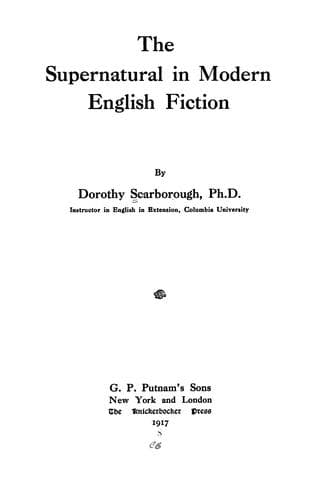
The Supernatural in Modern English FictionScarborough, Dorothy
History
The Supernatural in Modern English Fiction
Scarborough, Dorothy
English fiction -- History and criticism; Supernatural in literature
One feature that distinguishes the uncanny tales of to-day from the
Gothic is their greater range of material. The early terror story had
its source in popular superstition, classical literature, medieval
legends, or the Elizabethan drama, while in the century that has
elapsed since the decay of the Gothic novel as such, new fields of
thought have been opened up, and new sources for ghostly plots have
been discovered which the writers of modern stories are quick to
utilize. Present-day science with its wonderful development has
provided countless plots for supernatural stories. Comparative study
of folk-lore, with the activities of the numerous associations, has
brought to light fascinating material. Modern Spiritualism, with its
seances, its mediumistic experiments, has inspired many novels and
stories. The Psychical Research Society, with branches in various parts
of the world and its earnest advocates and serious investigations, has
collected suggestive stuff for many ghostly stories. The different
sources for plot material and mechanics for awesome effect, added
to these from which the terror novel drew its inspiration, have
incalculably enriched the supernatural fiction and widened the limits
far beyond the restrictions of the conventionalized Gothic.
Science has furnished themes for many modern stories of the
supernatural. Modern science itself, under normal conditions, seems
like necromancer's magic, so its incursion into thrilling fiction
is but natural. Every aspect of research and discovery has had its
exponent in fictive form, and the skill with which the material is
handled constitutes one point of difference between the present ghostly
stories and the crude scientific supernaturalism of the early novels.
The influence of Darwin, Spencer, Huxley, and other scientists of the
last century did much to quicken fiction as well as thought, and the
effects can be traced in the work of various authors.
The widespread interest in folk-lore in recent years has had an
appreciable influence on the stories of the supernatural. While the
methods of investigation followed by the serious students of folk-lore
are scientific and the results are tabulated in an analytic rather than
a literary style, yet the effect is helpful to fiction. Comparative
studies in folk-lore, by the bringing together of a mass of material
from diverse sources, establishes the fact of the universal acceptance
of supernaturalism in some form. Ethnic superstitions vary, yet there
is enough similarity between the ideas held by tribes and races so
widely separated as to discredit any basis of imitation or conscious
influence between them, to be of great interest to scientists. No
tribe, however low in the social scale, has been found that has no
belief in powers beyond the mortal.
Public-domain text, read in full here on John Shaqi.
Reviews
Reviews
No reviews yet
Be the first to share your thoughts on this work.
Elsewhere in the archive
Join the Discussion
Join the discussion
Sign in to leave a comment or review.
Sign InorCreate an account