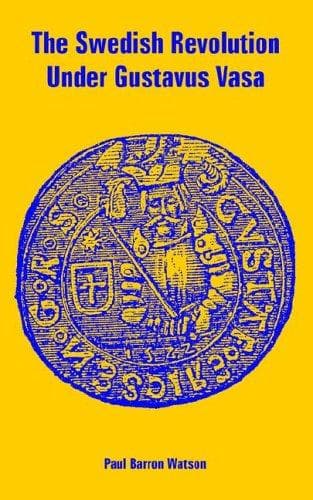
The Swedish Revolution Under Gustavus VasaWatson, Paul Barron
History
The Swedish Revolution Under Gustavus Vasa
Watson, Paul Barron
Gustav I Vasa, King of Sweden, 1496-1560; Sweden -- History -- Gustav I Vasa, 1523-1560
Meantime Slagheck had concentrated the Danish forces in and near the
Castle of Vesterås, deeming this the best point at which to hold the
patriots at bay. One detachment, indeed, proceeded north as far as the
Dalelf, on the southern frontier of Dalarne, and encamped there,
thinking to prevent the enemy from crossing. While waiting, the Danish
leader is said to have inquired the population of Dalarne, and on being
told that it was about twenty thousand, to have asked how the province
could support so many. The answer was that the people were not used to
dainties, that their only drink was water, and in hard times their only
food a bread made from the bark of trees. "Even the Devil," ejaculated
the officer, "could not vanquish men who live on wood and water;" and
with that he ordered a retreat. Before they got off, however, the Swedes
fell upon them and drove them home in flight. About the same time the
burgomaster and Council of Stockholm despatched a letter to the
northern provinces, urging them to pay no heed to the lies of Gustavus;
and Archbishop Trolle, after several epistles of a like nature, set sail
along the coast of the Baltic to the north to use his influence in
quelling the insurrection. But wherever he tried to land he was met by
the peasantry with threats and imprecations; and he soon beat a hasty
and ignominious retreat.[57]
On returning from his recruiting-tour to the headquarters of his army,
Gustavus put his men through a regular course of training. Most of them
were farmers, with scarce enough knowledge of military affairs to
distinguish a javelin from a flagstaff. Their weapons were of the rudest
sort,--axes and bows and arrows. He therefore taught them first of all
to forge javelin and arrow heads. He also introduced a pike with spiral
point which could be driven into a man's armor so as to hold him fast.
To meet the necessities of a soldier, who was prevented by his
occupation from paying for his goods with wheat or rye, Gustavus issued
a copper coin which was at once received as money. These preparations
seem all to have been made with the prospect of a long-continued war.
While they were in progress, a letter came from the burgomaster and
Council of Stockholm, dated April 10, and addressed to the people of
Dalarne, informing them that a number of vessels had just arrived from
the Hanse Towns, laden by order of Christiern with clothing and food,
which were to be distributed among the people. After administering this
mealy morsel the letter of the burgomaster and Council went on to urge
the Dalesmen to have nothing to do with the lies and treachery of
Gustavus, but to consider their own and their children's welfare and bow
humbly before their gracious king. This letter seems not to have
produced the effect that was intended. Another that came about the same
time was more effective. It was from some German soldiers who declared,
with more or less exaggeration, that they were four thousand strong,
Public-domain text, read in full here on John Shaqi.
Reviews
Reviews
No reviews yet
Be the first to share your thoughts on this work.
Elsewhere in the archive
Join the Discussion
Join the discussion
Sign in to leave a comment or review.
Sign InorCreate an account