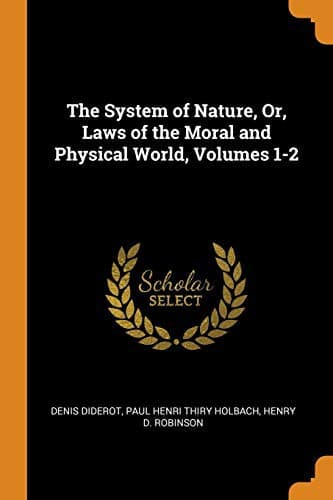
The System of Nature, or, the Laws of the Moral and Physical World. Volume 1Holbach, Paul Henri Thiry, baron d'
Religion
The System of Nature, or, the Laws of the Moral and Physical World. Volume 1
Holbach, Paul Henri Thiry, baron d'
Materialism; Philosophy and religion; Psychology
Motion, alternately communicated and received, establishes the
connection or relation between the different orders of beings: when they
are in the sphere of reciprocal action, attraction approximates
them; repulsion dissolves and separates them; the one strengthens and
preserves them; the other enfeebles and destroys them. Once combined,
they have a tendency to conserve themselves in that mode of existence,
by virtue of their _inert force_; in this they cannot succeed, because
they are exposed to the continual influence of all other beings, who
perpetually and successively act upon them; their change of form, their
dissolution, is requisite to the preservation of Nature herself: this is
the sole end we are able to assign her--to which we see her tend without
intermission--which she follows without interruption, by the destruction
and reproduction of all subordinate beings, who are obliged to submit to
her laws--to concur, by their mode of action, to the maintenance of her
active existence, so essentially requisite to the GREAT WHOLE.
It is thus each being is an individual, who, in the great family,
performs his necessary portion of the general labour--who executes the
unavoidable task assigned to him. All bodies act according to laws,
inherent in their peculiar essence, without the capability to swerve,
even for a single instant, from those according to which Nature herself
acts. This is the central power, to which all other powers, essences,
and energies, are submitted: she regulates the motions of beings, by the
necessity of her own peculiar essence: she makes them concur by various
modes to the general plan: this appears to be nothing more than the
life, action, and maintenance of the whole, by the continual change of
its parts. This object she obtains, in removing them, one by the other;
by that which establishes, and by that which destroys, the relation
subsisting between them; by that which gives them, and that which
deprives them of, their forms, combinations, proportions, and qualities,
according to which they act for a time, after a given mode; these are
afterwards taken from them, to make them act after a different manner.
It is thus that Nature makes them expand and change, grow and decline,
augment and diminish, approximate and remove, forms and destroys them,
according as she finds it requisite to maintain the whole; towards the
conservation which this Nature is herself essentially necessitated to
have a tendency.
Public-domain text, read in full here on John Shaqi.
Reviews
Reviews
No reviews yet
Be the first to share your thoughts on this work.
Join the Discussion
Join the discussion
Sign in to leave a comment or review.
Sign InorCreate an account