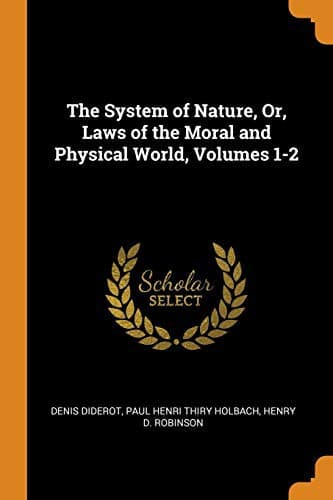
The System of Nature, or, the Laws of the Moral and Physical World. Volume 1Holbach, Paul Henri Thiry, baron d'
Religion
The System of Nature, or, the Laws of the Moral and Physical World. Volume 1
Holbach, Paul Henri Thiry, baron d'
Materialism; Philosophy and religion; Psychology
This irresistible power, this universal necessity, this general energy,
then, is only a consequence of the nature of things; by virtue of which
every thing acts, without intermission, after constant and immutable
laws: these laws not varying more for the whole than for the beings of
which it is composed. Nature is an active living whole, to which all its
parts necessarily concur; of which, without their own knowledge, they
maintain the activity, the life, and the existence. Nature acts and
exists necessarily: all that she contains, necessarily conspires to
perpetuate her active existence. This is the decided opinion of PLATO,
when he says, "_matter and necessity are the same thing; this necessity
is the mother of the world._" In point of fact, we cannot go beyond this
aphorism, MATTER ACTS, BECAUSE IT EXISTS; AND EXISTS, TO ACT. If it be
enquired how, or for why, matter exists? We answer, we know not: but
reasoning by analogy, of what we do not know by that which we do, we
should be of opinion it exists necessarily, or because it contains
within itself a sufficient reason for its existence. In supposing it to
be created or produced by a being distinguished from it, or less known
than itself, (which it may be, for any thing we know to the contrary,)
we must still admit, that this being is necessary, and includes a
sufficient reason for his own existence. We have not then removed any of
the difficulty, we have not thrown a clearer light upon the subject, we
have not advanced a single step; we have simply laid aside a being,
of which we know some few of the properties, but of which we are still
extremely ignorant, to have recourse to a power, of which it is utterly
impossible we can, as long as we are men, form any distinct idea; of
which, notwithstanding it may be a truth, we cannot, by any means we
possess, demonstrate the existence. As, therefore, these must be at best
but speculative points of belief, which each individual, by reason of
its obscurity, may contemplate with different optics, under various
aspects, they surely ought to be left free for each to judge after his
own fashion: the Hindoo can have no just cause of enmity against
the Christian for his faith: this has no moral right to question
the Mussulman upon his; the numerous sects of each of the various
persuasions spread over the face of the earth, ought to make it a creed
to look with an eye of complacency on the deviation of the others;
and rest upon that great moral axiom, which is strictly conformable
to Nature, which contains the whole of man's happiness--"_Do not unto
another, that which do you not wish another should do unto you_;" for it
is evident, according to their own doctrines, out of all the variety of
systems, one only can be right.
Public-domain text, read in full here on John Shaqi.
Reviews
Reviews
No reviews yet
Be the first to share your thoughts on this work.
Join the Discussion
Join the discussion
Sign in to leave a comment or review.
Sign InorCreate an account