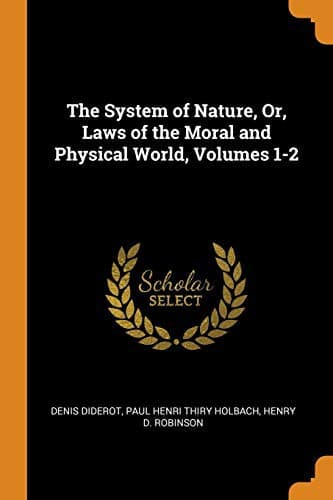
The System of Nature, or, the Laws of the Moral and Physical World. Volume 1Holbach, Paul Henri Thiry, baron d'
Religion
The System of Nature, or, the Laws of the Moral and Physical World. Volume 1
Holbach, Paul Henri Thiry, baron d'
Materialism; Philosophy and religion; Psychology
Man always makes himself the center of the universe: it is to himself
that he relates all he beholds. As soon as he believes he discovers a
mode of action that has a conformity with his own, or some phenomenon
that interests his feelings, he attributes it to a cause that resembles
himself--that acts after his manner--that has faculties similar to those
he possesses--whose interests are like his own--whose projects are in
unison with and have the same tendency as those he himself indulges: in
short, it is from himself, or the properties which actuate him, that he
forms the model of this cause. It is thus that man beholds, out of his
own species, nothing but beings who act differently from himself;
yet believes that he remarks in Nature an order similar to his own
ideas--views conformable to those which he himself possesses. He
imagines that Nature is governed by a cause whose intelligence is
conformable to his own, to whom he ascribes the honor of the order which
he believes he witnesses--of those views that fall in with those that
are peculiar to himself--of an aim which quadrates with that which is
the great end of all his own actions. It is true that man, feeling his
incapability of producing the vast, the multiplied effects of which he
witnesses the operation, when contemplating the universe, was under the
necessity of making a distinction between himself and the cause which
he supposed to be the author of such stupendous effects; he believed
he removed every difficulty, by amplifying in this cause all those
faculties of which he was himself in possession; adding others of which
his own self-love made him desirous, or which he thought would render
his being more perfect: thus, he gave JUPITER wings, with the faculty of
assuming any form he might deem convenient: it was thus, by degrees,
he arrived at forming an idea of that intelligent cause, which he has
placed above Nature, to preside over action--to give her that motion
of which he has chosen to believe she was in herself incapable. He
obstinately persists in regarding this Nature as a heap of dead, inert
matter, without form, which has not within itself the power of producing
any of those great effects, those regular phenomena, from which emanates
what he styles _the order of the Universe_. ANAXAGORAS is said to have
been the first who supposed the universe created and governed by an
intelligence: ARISTOTLE reproaches him with having made an automaton
of this intelligence; or in other words, with ascribing to it the
production of things, only when he was at a loss to account for their
appearance. From whence it may be deduced, that it is for want of being
acquainted with the powers of Nature, or the properties of matter, that
man has multiplied beings without necessity--that he has supposed the
universe under the government of an intelligent cause, which he is, and
perhaps always will be, himself the model: in fine, this cause has been
Public-domain text, read in full here on John Shaqi.
Reviews
Reviews
No reviews yet
Be the first to share your thoughts on this work.
Elsewhere in the archive
Join the Discussion
Join the discussion
Sign in to leave a comment or review.
Sign InorCreate an account