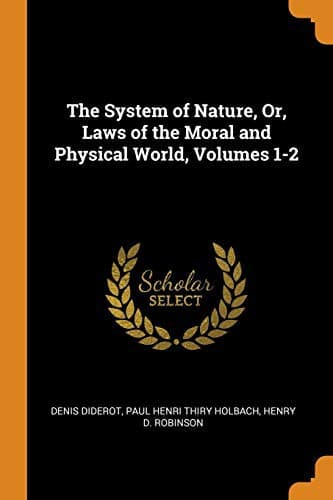
The System of Nature, or, the Laws of the Moral and Physical World. Volume 2Holbach, Paul Henri Thiry, baron d'
Religion
The System of Nature, or, the Laws of the Moral and Physical World. Volume 2
Holbach, Paul Henri Thiry, baron d'
Materialism; Philosophy and religion; Psychology
In order to justify these beings, constructed upon mortal principles,
from injustice, in consequence of the evils the human species
experience, the theologian is reduced to the necessity of calling them
punishments inflicted for the transgressions of man. But then these
general calamities include all men. Some, at least, may be supposed not
to have offended. Thus he involves contradictions he finds it difficult
to reconcile; to effectuate this he makes his _anthropomorphites_
immaterial--incorporeal; that is, he says they are the negation of every
thing of which he has a knowledge; consequently, beings who can have no
relation with corporeal beings: and this avails him no better, as
will be evident by reasoning on the subject. To offend any one, is to
diminish the sum of his happiness; it is to afflict him, to deprive
him of something, to make him experience a painful sensation. How is it
possible man can operate on such beings; how can the physical actions
of a material substance have any influence over an immaterial substance,
devoid of parts, having no point of contact. How can a corporeal being
make an incorporeal being experience incommodious sensations? On the
other hand, _justice_, according to the only ideas man can ever form of
it, supposes, a permanent disposition to render to each what is due
to him; the theologian will not admit that the beings he has jumbled
together owe any thing to man; he insists that the benefits they bestow
are all the gratuitous effects of their own goodness; that they have
the right to dispose of the work of their hands according to their
own pleasure; to plunge it if they please into the abyss of misery; in
short, that their volition is the only guide of their conduct. It is
easy to see, that according to man's idea of justice, this does not
even contain the shadow of it; that it is, in fact, the mode of action
adopted by what he calls the most frightful tyrants. How then can he
be induced to call men just who act after this manner? Indeed, while
he sees innocence suffering, virtue in tears, crime triumphant, vice
recompensed, and at the same time, is told the beings whom theology has
invented are the authors, he will never be able to acknowledge them
to have _justice_. But he will find no such contradictory qualities in
nature, where every thing is the result of immutable laws: he will at
once perceive that these transient evils produce more permanent good;
that they are necessary to the conservation of the whole, or else result
from modifications of matter, which it is competent for him to change,
by altering his own mode of action; a lesson that nature herself teaches
him when he is willing to receive her instructions. But to form gods
with human passions, is to make them appear unjust; to say that such
beings chastise their friends for their own I good, is at once to
upset all the ideas he has either of kindness or unkindness: thus
the incompatible human qualities ascribed to these beings, do in fact
Public-domain text, read in full here on John Shaqi.
Reviews
Reviews
No reviews yet
Be the first to share your thoughts on this work.
Elsewhere in the archive
Join the Discussion
Join the discussion
Sign in to leave a comment or review.
Sign InorCreate an account