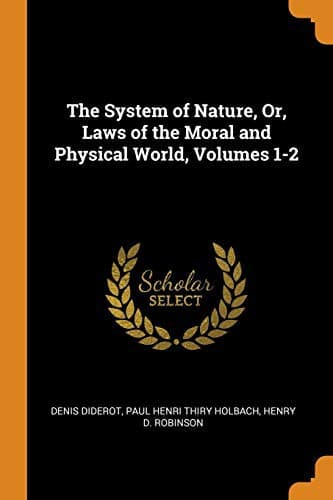
The System of Nature, or, the Laws of the Moral and Physical World. Volume 2Holbach, Paul Henri Thiry, baron d'
Religion
The System of Nature, or, the Laws of the Moral and Physical World. Volume 2
Holbach, Paul Henri Thiry, baron d'
Materialism; Philosophy and religion; Psychology
They will, nevertheless, reply to these difficulties, that goodness,
wisdom, justice, are in these beings qualities so pre-eminent, so
distinct, have so little affinity with these same qualities in man, that
they are totally dissimilar--have not the least relation. Admit this
to be the case, How then can he form to himself any idea of these
perfections, seeing they are totally unlike those with which he is
acquainted? They surely cannot mean to insinuate that they are the
reverse of every thing he understands; because that would, in effect,
bring them to a precise point which would not need any explanation;
it is therefore a matter of certainty this cannot be the case: then if
these qualities, when exercised by the beings they have described, are
only human actions so obscured, so hidden, as not to be recognizable by
man, How can weak mortals pretend to announce them, to have a knowledge
of them, to explain them to others? Does then theology impart to the
mind the ineffable boon of enabling it to conceive that which no man is
competent to understand? Does it procure for its agents the marvellous
faculty of having distinct ideas of beings composed of so many
contradictory properties? Does it, in fact, make the theologian himself
one of these incomprehensible beings.
They will impose silence, by saying the oracles have spoken; that
through these mystical means they have made themselves known to mortals.
The next question would naturally be, When, where, or to whom have
these oracles spoken? Where are these oracles? An hundred voices raise
themselves in the same moment; hands of Briaraeus are immediately
stretched forth to shew them in a number of discordant collections,
which each maintains, with an equal degree of vehemence, is the true
code--the only doctrine man ought to believe: he runs them over, finds
they scarcely agree in any one particular; but that in all the heaviest
penalties are denounced against those who doubt the smallest part of
any one of them. These beings of consummate wisdom are made to speak an
obscure, irrational language; some of them, although their goodness
is proclaimed, have been cruel and sanguinary; others, although their
justice is held forth, have been partial, unjust, capricious; some, who
are represented as all merciful, destine to the most hideous punishments
the unhappy victims to their wrath: examine any one of them more
closely, he will find that they have never in any two countries held
literally the same language: that although they are said to have spoken
in many places, that they have always spoken variously: What is the
necessary result? The human mind, incapable of reconciling such manifest
contradictions, unable to obtain from their ministers any corroborative
evidence, that is not disputed by the others, falls into the strangest
perplexity; is involved in doubts, entangled in a labyrinth to which no
clue is to be found.
Public-domain text, read in full here on John Shaqi.
Reviews
Reviews
No reviews yet
Be the first to share your thoughts on this work.
Elsewhere in the archive
Join the Discussion
Join the discussion
Sign in to leave a comment or review.
Sign InorCreate an account