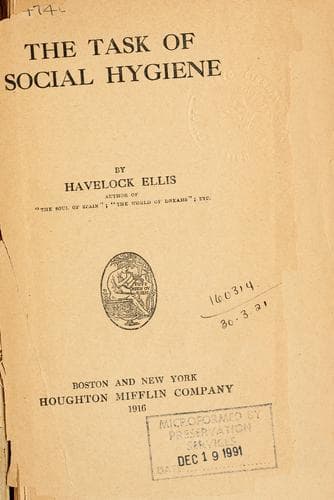
Eugenics; Sexual ethics; Women -- Social and moral questions
In so doing it will certainly tend also to destroy prostitution, which
is simply one of the forms in which the merging of sexual selection in
natural selection has shown itself. Wherever sexual selection has free
play, unhampered by economic considerations, prostitution is
impossible. The dominant type of marriage is, like prostitution, founded
on economic considerations; the woman often marries chiefly to earn her
living; here, too, we may certainly expect profound modifications. We
have long sought to preserve our social balance by placing an
unreasonable licence in the one scale, an equally unreasonable
abstinence in the other; the economic independence of women, tending to
render both extremes unnecessary, can alone place the sexual
relationships on a sound and free basis.
The State regulation of marriage has undoubtedly played a large and
important part in the evolution of society. At the present time the
advantages of this artificial control no longer appear so obvious
(even when the evidence of the law courts is put aside); they will
vanish altogether when women have attained complete economic
independence. With the disappearance of the artificial barriers in the
way of friendship between the sexes and of the economic motive to
sexual relationships--perhaps the two chief forces which now tend to
produce promiscuous sexual intercourse, whether dignified or not with
the name of marriage--men and women will be free to engage,
unhampered, in the search, so complicated in a highly civilized
condition of society, for a fitting mate.[49]
It is probable that this inevitable change will be brought about partly
by the voluntary action of individuals, and in greater measure by the
gradual and awkward method of shifting and ever freer divorce laws. The
slow disintegration of State-regulated marriage from the latter cause
may be observed now throughout the United States, where there is, on the
whole, a developing tendency to frequency and facility of divorce. It
is clear, however, that on this line marriage will not cease to be a
concern to the State, and it may be as well to point out at once the
important distinction between State-_regulated_ and State-_registered_
marriage. Sexual relationships, so long as they do not result in the
production of children, are matters in which the community has, as a
community, little or no concern, but as soon as a sexual relationship
results in the pregnancy of the woman the community is at once
interested. At this point it is clearly the duty of the State to
register the relationship.[50]
Public-domain text, read in full here on John Shaqi.
Reviews
Reviews
No reviews yet
Be the first to share your thoughts on this work.
Join the Discussion
Join the discussion
Sign in to leave a comment or review.
Sign InorCreate an account