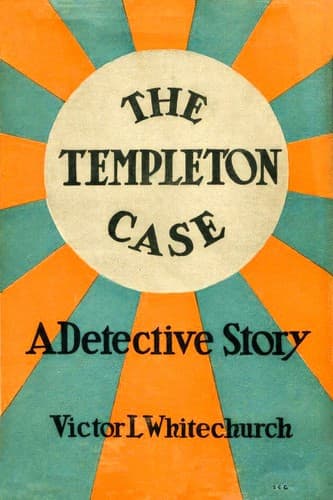
The Templeton caseWhitechurch, Victor L. (Victor Lorenzo)
General
The Templeton case
Whitechurch, Victor L. (Victor Lorenzo)
Detective and mystery stories; Murder -- Investigation -- Fiction; Police -- England -- Fiction
“So I found,” said the poacher brazenly. “Now—that ’ere wood, t’other
side o’ the water. Sometimes there’s a goodish few—sparrers, we’ll
say—to be found there, and it wouldn’t ha’ been the first time as I’d
borrowed one o’ they canoes and slipped over for an hour or so. O’
course I returned the canoe when I’d finished. I ain’t no thief—thank
Gawd!”
The others grinned at him, but were silent. It was best for the man to
tell his story in his own way.
“It was between half-past twelve and one as I got down to the quay—I
allus reckons to know the time within a few minutes—’tis a habit o’
mine. There was no one about and ’twas a still night. There was a
light on board that ’ere little yacht where the murder was, but I
didn’t hear any sound. I was a-standin’ on the quay, a-makin’ up my
mind whether ’twas worth while crossing over, when I heard the sound
of a boat bein’ pulled across—from the other side.”
“From the _other_ side?” asked Colson.
“That’s right. I wondered what anyone was a-doin’ that time o’
night—when respectable folk ought to be abed and asleep.” He grinned.
“I can see pretty well in the dark—I _has_ to in my perfession—so I
jist lay low and watched. Whoever it was, he warn’t no boatman, by the
way he mucked that ’ere boat about. The tide was flowin’ in and he had
to pull hard. When he got across he made straight for that ’ere yacht
where the lights was burnin’. Clumsy, he was, too. He didn’t ’arf bump
the nose o’ his boat into the yacht when he got to her. You could hear
the bang all over the place.”
“What did he do then?”
“Why, Major, he got aboard the yacht and went in the cabin. I see him
quite plainly. But he never stayed there long. In less than five
minutes he was out again, clamberin’ into the boat, and pullin’ away
across stream as hard as ever he could go. Seemed in a mighty hurry,
he did. Just then I heard the Cathedral clock strike one.”
“What did you do?”
“I lit a pipe and waited a bit—quarter of an hour or less, I reckon. I
was thinkin’ it wouldn’t do to cross over to the wood that night. And
then the motor-car come along.”
“The motor-car!” ejaculated the superintendent.
“Yes, sir—come down the road.”
“To the quay?”
“No, sir. It stopped about thirty or forty yards before it got to the
quay. I could see the lights.”
“Did you see who was in it?”
“No, sir; I made tracks along the shore. Thinks I, ‘There’s too many
folks about to-night for an honest chap to get a livin’,’ so I come
straight home. And that’s all about it.”
They questioned him sharply, but he stuck to his story. Then the
superintendent said:
“You’ll probably have to tell all this to the jury—at the adjourned
inquest.”
“It won’t get me into no trouble?” asked Thatcher.
“No,” said the superintendent. “We’ll see to that.”
“Because,” went on the man as he rose to go, “I’ve got my reputation
to think of.”
“We know all about that. And look here, Thatcher, keep your mouth
shut,” said the superintendent.
Public-domain text, read in full here on John Shaqi.
Reviews
Reviews
No reviews yet
Be the first to share your thoughts on this work.
Join the Discussion
Join the discussion
Sign in to leave a comment or review.
Sign InorCreate an account