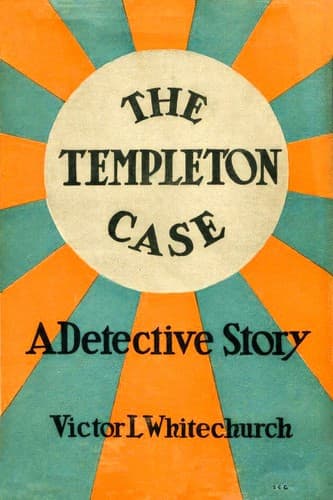
The Templeton caseWhitechurch, Victor L. (Victor Lorenzo)
General
The Templeton case
Whitechurch, Victor L. (Victor Lorenzo)
Detective and mystery stories; Murder -- Investigation -- Fiction; Police -- England -- Fiction
“See here, Mr. Moss. We police have a duty to do, but no innocent
person need be afraid of us. We only want to secure the guilty. And
we’re always ready to help the innocent when we can. We know you were
on Mr. Templeton’s yacht—we know he had been with you on Saturday
afternoon—and we know you left in the devil of a hurry and took these
diamonds with you. You will serve your purpose, and ours, best by
telling us all you know.”
Isaac Moss took out his cigarette case.
“Do you mind if I smoke?”
“By all means.”
He poured himself out some more whisky, drank it and said:
“Where do you want me to begin?”
“At the point when you had an interview with Templeton on Saturday
afternoon. Tell us _why_ he came to you.”
“It was about these diamonds. I am agent for a firm in South Africa,
Ehbrenstein & Co.—a well-known firm. They wrote telling me they had a
consignment of uncut stones which they wished me to take to
Amsterdam—to be cut, in the usual way of business. We are always very
careful, of course, in these consignments, and if there is anyone well
known to the firms or dealers coming over, it is a common thing to ask
him to bring them. My letter of advice told me that Mr. Templeton—whom
I knew slightly—would bring them over, and that I was to give him the
receipt on delivery. It would, of course, be a matter of commission
for him. The letter also said that he would communicate with me when
he reached England. He didn’t at first. I knew the boat on which he
was sailing had arrived in Plymouth, and grew anxious, especially as I
knew that Templeton was an erratic and peculiar man, with little
regard for business methods. Then I heard from him—from Poole—saying
he was yachting on the South Coast, probably finishing up at a little
place called Marsh Quay, when he would run up to town and deliver the
stones. He also told me to write to him at the G.P.O., Ryde, if I had
anything to say. I was getting still more anxious, and wrote at once,
suggesting that as, by a coincidence, I had a week-end place at Marsh
Quay, he should bring me the stones there. I described exactly where
my house stood. He replied saying he would be with me on Saturday
afternoon.”
“Yes, we know that,” said the superintendent.
“I was sitting on my lawn when he came. We talked a bit there, and
then went into the house—into my study, and had a whisky and soda
each. It was there that he produced these stones—in a little bag like
this one—and I turned them out on the table and counted them. There
were thirty-two—the correct number. I put them back in the bag and
gave him the receipt. Just before he went he said, ‘I’d like to keep
that little bag. I’ve carried it a good many hundred miles.’ I said,
‘Certainly.’ I unlocked a drawer in my writing-desk, emptied the
stones into a little tin box, locked it up and gave him the bag. Then
I walked down to my landing-stage and watched him row back to his
yacht. That was the last I saw of him—alive.”
Public-domain text, read in full here on John Shaqi.
Reviews
Reviews
No reviews yet
Be the first to share your thoughts on this work.
Elsewhere in the archive
Join the Discussion
Join the discussion
Sign in to leave a comment or review.
Sign InorCreate an account