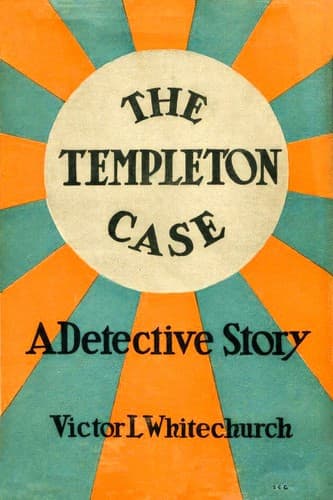
The Templeton caseWhitechurch, Victor L. (Victor Lorenzo)
General
The Templeton case
Whitechurch, Victor L. (Victor Lorenzo)
Detective and mystery stories; Murder -- Investigation -- Fiction; Police -- England -- Fiction
When the manager and the others had gone, the superintendent said:
“Well, Mr. Moss, I’ve decided not to take you into custody, though I
may as well tell you now that I quite intended to do so. You’ve been
exceedingly imprudent, and you’ve had a narrow escape. As to these
diamonds”—he had put them back in the bag and pocketed them—“can you
satisfy me that you have a right to them?”
“I have all the correspondence relating to them in my office—and I can
bring another proof. Ehbrenstein & Co. sent full particulars of the
transaction to another of their London agents—this is frequently done,
as a covering precaution.”
“Very good, we will return to your office and see this agent. If it is
as you say, I am prepared to leave the stones with you.”
“How about—how about the other stone—you found it on Mr. Templeton, I
hope?”
The man’s Jewish instincts were predominating now that the crisis was
over.
“You’ll get that—in good time. Now, Mr. Moss, I don’t want to have any
further trouble with you. If all is as you say, and I allow you your
freedom, you must be prepared to tell your story to the jury at the
remanded inquest. You understand?”
“Do you think,” hesitated Moss, a little of his terror returning,
“that they’d be likely to return a verdict of—of—murder against me?”
“It doesn’t matter in the least what they do,” said the policeman with
fine sarcasm in his opinion of the brain powers of the “twelve good
men and true.” “It’s only a coroner’s jury. We might have, in that
case, for form’s sake, to bring you before the magistrates’ court. But
you’d never get committed for trial. _We’ll_ see to that.”
The end of it was that the superintendent expressed himself satisfied,
released Isaac Moss, and returned to Frattenbury with Colson. In the
course of the journey the detective remarked:
“I never expected we should find Moss to be our man. When I showed his
housekeeper and her husband that stick this morning, pretending I had
found it in their master’s boat, and they both denied that they had
ever seen it before, I felt pretty certain. Besides, I thought
beforehand that the stick was too long to be used by a little man like
Moss. Well, that settles _his_ book,” and he rubbed his hands. “We’ve
eliminated _two_ out of the three. Now we’ll go for the last one. A
cigar merchant, eh, sir? That’s a bit significant.”
The superintendent nodded.
“What are you going to do, Colson?”
“Leave that to me for a bit, sir. I’ve got a card up my sleeve that
ought to take the trick. And I’ll play it—before the adjourned
inquest!”
Smoking his pipe that evening, in his snug little home, he related the
events of the day to his wife.
“And now for Mr. Joseph Proctor, retired cigar merchant!” he exclaimed
gleefully.
She took his hand as she sat beside him.
“Be careful dear!” she said.
“Why?”
“You’ve just told me that Mr. Moss is a little man, and would scarcely
have carried a long walking-stick.”
“Well?”
“Isn’t Mr. Proctor a little man, too?”
Public-domain text, read in full here on John Shaqi.
Reviews
Reviews
No reviews yet
Be the first to share your thoughts on this work.
Elsewhere in the archive
Join the Discussion
Join the discussion
Sign in to leave a comment or review.
Sign InorCreate an account