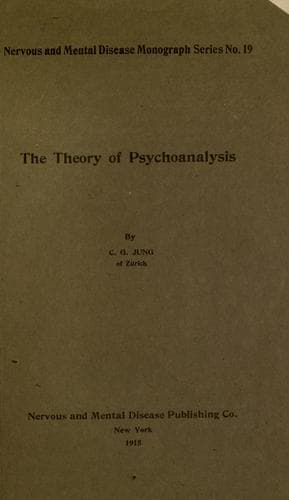
The Theory of PsychoanalysisJung, C. G. (Carl Gustav)
Science
The Theory of Psychoanalysis
Jung, C. G. (Carl Gustav)
Neuroses; Psychoanalysis; Psychology, Pathological; Sex
In association-experiments, we are able to recognize the very
intense effects produced by the unconscious in what are called
complex-interventions. These mistakes made in the association-experiment
are nothing but the prototypes of the mistakes made in everyday life,
which are for the greater part to be considered as interventions. Freud
brought together such material in his book, “The Psychopathology of
Everyday Life.”
These include the so-called symptomatic actions, which from another
point of view might equally as well be called “symbolic actions,” and
the real failures to carry out actions, such as forgetting, slips of
the tongue, etc. All these phenomena are the effect of unconscious
constellations and therefore so many entrance-gates into the domain of
the unconscious. When such errors are cumulative, they are designated
as neurosis, which, from this aspect, looks like a defective action
and therefore the effect of unconscious constellations or
complex-interventions.
The association-experiment is thus not directly a means to unlock the
unconscious, but rather a technique for obtaining a good selection of
defective reactions, which can then be used by psychoanalysis. At least,
this is its most reliable form of application at the present time. I
may, however, mention that it is possible that it may furnish other
especially valuable facts which would grant us some direct glimpses, but
I do not consider this problem sufficiently ripe to speak about.
Investigations in this direction are going on.
I hope that, through my explanation of our method, you may have gained
somewhat more confidence in its scientific character, so that you will
be by this time more inclined to agree that the phantasies which have
been hitherto discovered by means of psychoanalytic work are not merely
arbitrary suppositions and illusions of psychoanalysts. Perhaps you are
even inclined to listen patiently to what those products of unconscious
phantasies can tell us.
Footnote 9:
Jahrbuch für psychopath. u. psychoanalyt. Forschungen, Bd. II, p. 465.
CHAPTER VII
The Content of the Unconscious
Public-domain text, read in full here on John Shaqi.
Reviews
Reviews
No reviews yet
Be the first to share your thoughts on this work.
Join the Discussion
Join the discussion
Sign in to leave a comment or review.
Sign InorCreate an account