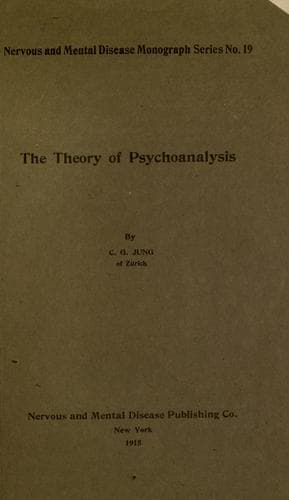
The Theory of PsychoanalysisJung, C. G. (Carl Gustav)
Science
The Theory of Psychoanalysis
Jung, C. G. (Carl Gustav)
Neuroses; Psychoanalysis; Psychology, Pathological; Sex
The phantasies of adults are, in so far as they are conscious, of great
diversity and strongly individual. It is therefore nearly impossible to
give a general description of them. But it is very different when we
enter by means of analysis into the world of his unconscious phantasies.
The diversities of the phantasies are indeed very great, but we do not
find those individual peculiarities which we find in the conscious self.
We meet here with more typical material which is not infrequently
repeated in a similar form in different people. Constantly recurring,
for instance, are ideas which are variations of the thoughts we
encounter in religion and mythology. This fact is so convincing that we
say we have discovered in these phantasies the same mechanisms which
once created mythological and religious ideas. I should have to enter
very much into detail in order to give you adequate examples. I must
refer you for these problems to my work, “Wandlungen und Symbole der
Libido.” I will only mention that, for instance, the central symbol of
Christianity—self-sacrifice—plays an important part in the phantasies of
the unconscious. The Viennese School describes this phenomenon by the
ambiguous term castration-complex. This paradoxical use of the term
follows from the particular attitude of this school toward the question
of unconscious sexuality. I have given special attention to the problem
in the book I have just mentioned; I must here restrict myself to this
incidental reference and hasten to say something about the origin of the
unconscious phantasy.
Public-domain text, read in full here on John Shaqi.
Reviews
Reviews
No reviews yet
Be the first to share your thoughts on this work.
Join the Discussion
Join the discussion
Sign in to leave a comment or review.
Sign InorCreate an account