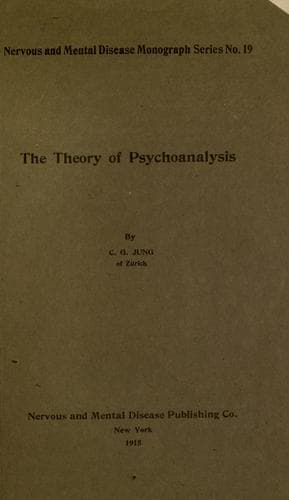
The Theory of PsychoanalysisJung, C. G. (Carl Gustav)
Science
The Theory of Psychoanalysis
Jung, C. G. (Carl Gustav)
Neuroses; Psychoanalysis; Psychology, Pathological; Sex
astonishing if little girls possess the Œdipus-complex too. As far as I
can see, the first love of the child belongs to the mother, no matter
which its sex. If the love for the mother at this stage is intense, the
father is jealously kept away as a rival. Of course, for the child
itself, the mother has in this early stage of childhood no sexual
significance of any importance. The term “Œdipus-complex” is in so far
not really suitable. At this stage the mother has still the significance
of a protecting, enveloping, food-providing being, who, on this account,
is a source of delight. I do not identify, as I explained before, the
feeling of delight eo ipso with sexuality. In earliest childhood but a
slight amount of sexuality is connected with this feeling of delight.
But, nevertheless, jealousy can play a great part in it, as jealousy
does not belong entirely to the sphere of sexuality. The desire for food
has much to do with the first impulses of jealousy. Certainly, a
relatively germinating eroticism is also connected with it. This element
gradually increases as the years go on, so that the Œdipus-complex soon
assumes its classical form. In the case of the son, the conflict
develops in a more masculine and therefore more typical form, whilst in
the daughter, the typical affection for the father develops, with a
correspondingly jealous attitude toward the mother. We call this
complex, the _Electra-complex_. As everybody knows, Electra took revenge
on her mother for the murder of her husband, because that mother had
robbed her of her father.
Public-domain text, read in full here on John Shaqi.
Reviews
Reviews
No reviews yet
Be the first to share your thoughts on this work.
Join the Discussion
Join the discussion
Sign in to leave a comment or review.
Sign InorCreate an account