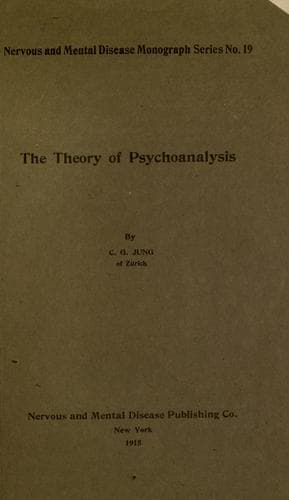
The Theory of PsychoanalysisJung, C. G. (Carl Gustav)
Science
The Theory of Psychoanalysis
Jung, C. G. (Carl Gustav)
Neuroses; Psychoanalysis; Psychology, Pathological; Sex
With this conception of Freud’s we have to return to the question of the
etiology of the neuroses. We have seen that the psychoanalytic theory
began with a traumatic event in childhood, which was only later on found
to be a phantasy, at least in many cases. In consequence, the theory
became modified, and tried to find in the development of abnormal
phantasy the main etiological significance. The investigation of the
unconscious, made by the collaboration of many workers, carried on over
a space of ten years, provided an extensive empirical material, which
demonstrated that the incest-complex was the beginning of the morbid
phantasies. But it was no longer thought that the incest-complex was a
special complex of neurotic people. It was demonstrated to be a
constituent of a normal infantile psyche too. We cannot tell, by its
mere existence, if this complex will give rise to a neurosis or not. To
become pathogenic, it must give rise to a conflict; that is, the
complex, which in itself is harmless, has to become dynamic, and thus
give rise to a conflict.
Herewith, we come to a new and important question. The whole etiological
problem is altered, if the infantile “root-complex” is only a general
form, which is not pathogenic in itself, and requires, as we saw in our
previous exposition, to be subsequently set in action. Under these
circumstances, we dig in vain among the reminiscences of earliest
childhood, as they give us only the general forms of the later
conflicts, but not the conflict itself.
I believe the best thing I can do is to describe the further development
of the theory by demonstrating the case of that young lady whose story
you have heard in part in one of the former lectures. You will probably
remember that the shying of the horses, by means of the anamnestic
explanation, brought back the reminiscence of a comparable scene in
childhood. We here discussed the trauma theory. We found that we had to
look for the real pathological element in the exaggerated phantasy,
which took its origin in a certain retardation of the psychic sexual
development. We have now to apply our theoretical standpoint to the
origin of this particular type of illness, so that we may understand
how, just at that moment, this event of her childhood, which seemed to
be of such potency, could come to constellation.
Public-domain text, read in full here on John Shaqi.
Reviews
Reviews
No reviews yet
Be the first to share your thoughts on this work.
Elsewhere in the archive
Join the Discussion
Join the discussion
Sign in to leave a comment or review.
Sign InorCreate an account