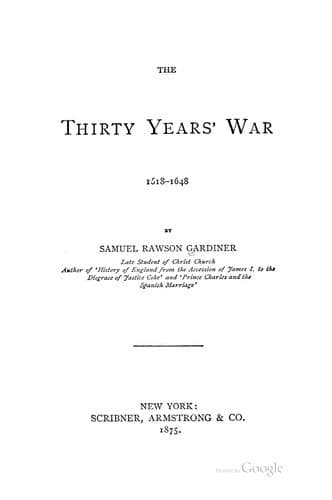
The Thirty Years' War, 1618-1648Gardiner, Samuel Rawson
History
The Thirty Years' War, 1618-1648
Gardiner, Samuel Rawson
Thirty Years' War, 1618-1648
The year 1624 brought with it fresh alarm. The empire, hostile to Sweden
and the religion of Sweden, was growing terribly strong. Unlike
Christian of Denmark, Gustavus had sympathized with Frederick's Bohemian
undertaking, although he had expected but little from an enterprise
under Frederick's guidance. And now the tide of victory was running
northward. An empire with a firm grasp on the shores of Mecklenburg and
Pomerania would soon call in question the Swedish dominion of the
Baltic. If this was to be the end, Gustavus had gained but little by his
victories over Russia and Poland.
[Sidenote: § 10. Character of his policy.]
It all sounds like mere selfishness,--Christian alarmed for his family
bishoprics, and his hold upon the Elbe and the Weser; Gustavus providing
against an attack upon his lordship in the Baltic. But it does not
follow that with both of them, and especially with Gustavus, the defence
of the persecuted Gospel was not a very real thing. Historians coolly
dissect a man's thoughts as they please, and label them like specimens
in a naturalist's cabinet. Such a thing, they argue, was done for mere
personal aggrandizement; such a thing for national objects; such a thing
from high religious motives. In real life we may be sure it was not so.
As with Ferdinand and Maximilian, the love of law and orderly government
was indissolubly blended with the desire to propagate the faith on which
their own spiritual life was based; so it was with Gustavus. To extend
the power of Sweden, to support the princes of Germany against the
Emperor's encroachments, to give a firm and unassailable standing ground
to German Protestantism, were all to him parts of one great work,
scarcely even in thought to be separated from one another. And, after
all, let it never be forgotten that the unity which he attacked was the
unity of the Jesuit and the soldier. It had no national standing ground
at all. The Germany of a future day, the Germany of free intelligence
and ordered discipline, would have far more in common with the destroyer
than with the upholder of the hollow unity of the seventeenth century.
SECTION II.--_English Diplomacy._
[Sidenote: § 1. English proposal to Sweden and Denmark.]
In August 1624 two English ambassadors, Sir Robert Anstruther and Sir
James Spens, set out from London; the first to the King of Denmark, the
second to the King of Sweden. The object of the embassies was identical,
to urge upon the two kings the necessity of stirring themselves up to
take part in a war for the recovery of the Palatinate, and for the
re-establishment of the old condition of things in Germany.
[Sidenote: § 2. The Danish answer.]
Public-domain text, read in full here on John Shaqi.
Reviews
Reviews
No reviews yet
Be the first to share your thoughts on this work.
Join the Discussion
Join the discussion
Sign in to leave a comment or review.
Sign InorCreate an account