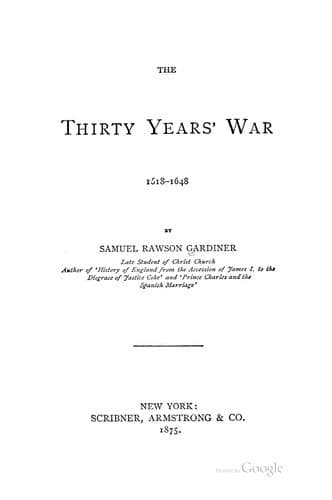
The Thirty Years' War, 1618-1648Gardiner, Samuel Rawson
History
The Thirty Years' War, 1618-1648
Gardiner, Samuel Rawson
Thirty Years' War, 1618-1648
The substitution of contributions for pillage may have seemed to
Ferdinand a mode of having recourse to a legal, orderly way of making
war. Unfortunately for him, it was not so. As the civil laws of the
Empire gave him no right to raise a penny for military purposes without
the assent of the Diet, and as, in the distracted condition of Germany,
the Diet was no longer available for the purpose, no one was likely to
regard money so raised as legal in any sense at all. In fact, it could
only be justified as Charles I. justified the forced loan of 1626, as an
act done out of the plenitude of power inherent in the Crown,
authorizing him to provide in cases of emergency for the good of his
subjects. Ferdinand, in truth had brought himself into a position from
which he could neither advance nor retreat with honour. If he did not
accept Wallenstein's services he would almost certainly be beaten. If he
did accept them, he would almost certainly raise a feeling in Germany
which would provoke a still stronger opposition than that which he had
for the present to deal with.
[Sidenote: § 9. Moderation impossible to Wallenstein.]
For the contributions were to be raised by military authority, with no
check or control whatever from civil officials. Even if the utmost
moderation was used there was something utterly exasperating to the
peasant or the townsman in having to pay over a greater or less share of
his hoardings to a colonel who had no civil authority to produce, and
who had no limit to his demands excepting in his own conscience. Those
who expected that moderation would be used must have formed a very
sanguine idea of the influence of the events of the war upon ordinary
military character.
[Sidenote: § 10. Wallenstein's army.]
In point of fact, neither Wallenstein nor his soldiers thought of
moderation. With him there was just enough of regularity to preserve the
discipline he needed; just enough order to wring the utmost possible
amount of money out of the country. 'God help the land to which these
men come,' was the natural exclamation of a frightened official who
watched the troops march past him.
[Sidenote: § 11. Explanation of Wallenstein's success.]
Public-domain text, read in full here on John Shaqi.
Reviews
Reviews
No reviews yet
Be the first to share your thoughts on this work.
Elsewhere in the archive
Join the Discussion
Join the discussion
Sign in to leave a comment or review.
Sign InorCreate an account