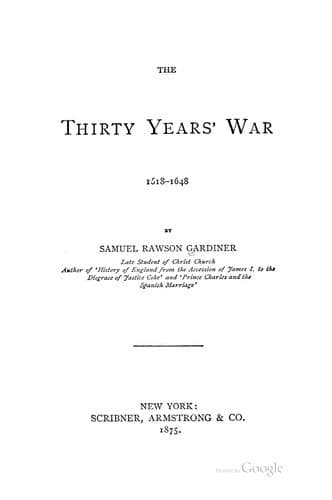
The Thirty Years' War, 1618-1648Gardiner, Samuel Rawson
History
The Thirty Years' War, 1618-1648
Gardiner, Samuel Rawson
Thirty Years' War, 1618-1648
It was a new power in Germany, a power which had no connexion with the
princes of the Empire, scarcely more than a nominal connexion with the
Emperor himself. And the man who wielded it was not even a German. By
his birth he was a Bohemian, of Slavonian race. The foremost men of the
war, Tilly, Wallenstein, Gustavus, were foreigners. Germany had failed
to produce either a statesman or a warrior of the first rank.
[Sidenote: 1626.
§ 14. Failure of peace negotiations.]
During the winter, negotiations for peace were opened at Brunswick. But
they foundered on the old rock. The Emperor and the League would grant
the terms of Mühlhausen and nothing more. It was against their
consciences to grant a permanent guarantee to the Protestant
administrators, and to admit them to the full enjoyment of the
privileges of princes of the Empire. With this the Lower Saxon princes
refused to be contented. Amongst the means by which the chapters had
secured their Protestant character were some acts of formal and even of
technical illegality. Such acts might easily be made use of by the
Emperor and his council to effect an alteration in the character of
those bodies. The Emperor and his council might possibly intend to be
just, but somehow or another they always contrived to decide disputed
questions in favour of their own partisans. On behalf of the religious
and political institutions of Protestant Germany, the King of Denmark
and his allies refused to accept the terms which had been offered them,
and demanded that Protestant territories should receive a legal and
permanent confirmation of their right to continue Protestant.
SECTION IV.--_Defeat of Mansfeld and Christian IV._
[Sidenote: § 1. Campaign of 1626.]
When the campaign opened, in the spring of 1626, the numbers at the
disposal of the two belligerents were not so very unequal. Wallenstein's
forces had been swelling far beyond his original reckoning. He and Tilly
together, it is said could command the services of 70,000 men, whilst
60,000 were ready to march against them. On Christian's side were
fighting Mansfeld and Christian of Brunswick, and a nobler than either,
John Ernest of Saxe-Weimar, on whom, first of German men, the idea had
dawned of composing the distractions of his fatherland by proclaiming a
general toleration. Bethlen Gabor was once more threatening Vienna from
the side of Hungary. Even the Protestant peasants in Lower Austria had
risen in defence of their religion and their homes against the Bavarian
garrisons which guarded the land till their master's expenses had been
paid.
[Sidenote: § 2. Christian IV. at a disadvantage.]
Public-domain text, read in full here on John Shaqi.
Reviews
Reviews
No reviews yet
Be the first to share your thoughts on this work.
Elsewhere in the archive
Join the Discussion
Join the discussion
Sign in to leave a comment or review.
Sign InorCreate an account