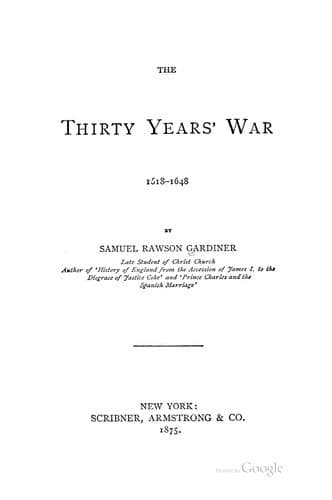
The Thirty Years' War, 1618-1648Gardiner, Samuel Rawson
History
The Thirty Years' War, 1618-1648
Gardiner, Samuel Rawson
Thirty Years' War, 1618-1648
[Sidenote: § 7. Mansfeld's march towards Hungary.]
Not long after Mansfeld's defeat at the bridge of Dessau, Christian of
Brunswick died. The remaining chiefs of the Danish party had a desperate
game to play. Mansfeld, reinforced by John Ernest of Weimar, was
dispatched through Silesia, to hold out a hand to Bethlen Gabor.
Wallenstein followed in pursuit, after sending some of his regiments to
the assistance of Tilly.
[Sidenote: § 8. The battle of Lutter.]
What could Christian do in the face of the danger? The English subsidies
did not come. To remain on the defensive was to court starvation, with
its inevitable accompaniment, mutiny. Elated by a slight success over
the enemy, he made a dash at Thuringia, hoping to slip through into
Bohemia, and to combine with Bethlen Gabor and Mansfeld in raising the
old Protestant flag in the heart of the Emperor's hereditary dominions.
But Tilly was on the watch. On August 27 he came up with the Danish army
at Lutter. The fight was fiercely contested. But before it was decided a
cry arose from some of the men in the Danish ranks that they would fight
no longer without pay. Christian was driven from the field. In after
days he complained bitterly that if the King of England had fulfilled
his promises the battle would have ended otherwise.
[Sidenote: § 9. Mansfeld's death.]
The soldiers lent by Wallenstein to Tilly had borne them well in the
fight. Wallenstein himself was far away. Mansfeld had been welcomed by
the Protestants of Silesia, and when Wallenstein followed he found the
principal towns garrisoned by the enemy. By the time he reached Hungary
Mansfeld had joined Bethlen Gabor. Once more Wallenstein pursued his old
tactics. Taking up a strong position, he left his opponents to do what
they could. The events showed that his calculations were well founded.
Bethlen Gabor had counted on help from the Turks. But the Turks gave him
no adequate assistance, and he did not venture to repeat unaided the
operation of the bridge of Dessau, and to attack Wallenstein in his
entrenchments. He preferred making a truce, one of the conditions of
which was that Mansfeld should be expelled from Hungary. On his way to
Venice the great adventurer was seized by a mortal disease. The
unconquerable man, like an old northern warrior, refused to die in a
bed. 'Raise me up,' he said to his friends, 'I am dying now.' Propped up
in an upright position in their arms, and gazing out upon the dawn,
which was lighting up the hills with the first rays of morning, he
passed away. 'Be united, united,' he murmured with his last breath;
'hold out like men.' His own absence from the scene would perhaps remove
one of the chief difficulties in the way of union.
CHAPTER VI.
STRALSUND AND ROCHELLE.
SECTION I.--_Fresh Successes of Wallenstein._
[Sidenote: 1626.
§ 1. Confiscations in the north.]
Public-domain text, read in full here on John Shaqi.
Reviews
Reviews
No reviews yet
Be the first to share your thoughts on this work.
Elsewhere in the archive
Join the Discussion
Join the discussion
Sign in to leave a comment or review.
Sign InorCreate an account