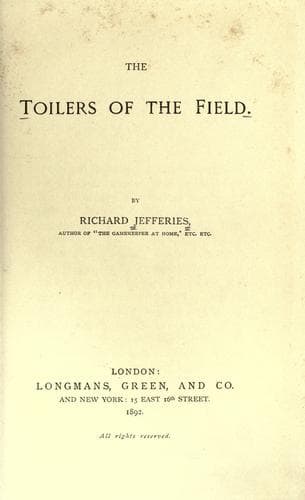
Agricultural laborers -- England; Country life -- England
Growing plainer and plainer as years go by, the elder women are wrinkled
and worn-looking, and have contracted a perpetual stoop. Many live to a
great age. In small parishes it is common to find a large number of
women of seventy and eighty, and there are few cottages which do not
contain an old woman. This is hardly a result in accordance with the
labour they have undergone. The explanation probably is that, continued
through a series of generations, it has produced a strength and stamina
which can survive almost anything. Certain it is that young couples
about to marry often experience much difficulty in finding cottages,
because they are occupied by extremely aged pairs; and landlords,
anxious to tear down and remove old cottages tumbling to pieces, are
restrained from doing so out of regard for the aged tenants, who cling
with a species of superstitious tenderness to the crumbling walls and
decayed thatch. At this age, at seventy-five or even eighty, the
agricultural woman retains a strength of body astonishing to a town-bred
woman. She will walk eight or ten miles, without apparent fatigue, to
and from the nearest town for her provisions. She will almost to the
last carry her prong out into the hayfield, and do a little work in some
corner, and bear her part in the gleaning after the harvest. She lives
almost entirely upon weak tea and bread sops. Her mental powers continue
nearly unimpaired, and her eyes are still good, though her teeth have
long gone. She will laugh over memories of practical jokes played at
harvest-homes half-a-century ago; and slowly spells over the service in
a prayer-book which asks blessings upon a king instead of a queen. She
often keeps the village "confectioner's" shop--_i.e._, a few bottles of
sweets and jumbles in the window, side by side with "twists" of whipcord
for the ploughboys and carters, and perhaps has a license for tobacco
and snuff.
But long before this age they have in most cases been kept by the
parish. The farmers who form the guardians know well the history of the
poor of their parishes, and remembering the long years of hard work,
always allow as liberal a relief as they can to these women. Out of all
their many children and grandchildren, it may happen that one has got on
fairly well in life, has a business as a blacksmith, or tinker, or
carpenter, and gives her a shilling or so a week; and a shilling goes a
long way with a woman who lives upon tea and sops. In their latter days
these women resemble the pollard oaks, which linger on year after year,
and finally fall from sheer decay.
_AN ENGLISH HOMESTEAD._
Public-domain text, read in full here on John Shaqi.
Reviews
Reviews
No reviews yet
Be the first to share your thoughts on this work.
Elsewhere in the archive
Join the Discussion
Join the discussion
Sign in to leave a comment or review.
Sign InorCreate an account