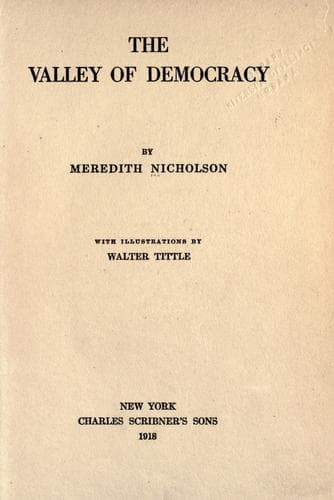
Mississippi River Valley -- Social life and customs
The farmer, in the years before he found that he must become a
scientist and a business man to achieve success, was the prey
of a great variety of sharpers. Tumble-down barns bristled with
lightning-rods that cost more than the structures were worth. A man
who had sold cooking-ranges to farmers once told me of the delights of
that occupation. A carload of ranges would be shipped to a county-seat
and transferred to wagons. It was the agent’s game to arrive at the
home of a good “prospect” shortly before noon, take down the old,
ramshackle cook-stove, set up the new and glittering range, and assist
the womenfolk to prepare a meal. The farmer, coming in from the fields
and finding his wife enchanted, would order a range and sign notes
for payment. These obligations, after the county had been thoroughly
exploited, would be discounted at the local bank. In this way the
farmer’s wife got a convenient range she would never have thought of
buying in town, and her husband paid an exorbitant price for it.
The farmer’s wife was, in this period to which I am referring, a poor
drudge who appeared at the back door of her town customers on Saturday
mornings with eggs and butter. She was copartner with her husband, but,
even though she might have “brought” him additional acres at marriage,
her spending-money was limited to the income from butter, eggs, and
poultry, and even this was dependent upon the generosity of the head of
the house. Her kitchen was furnished with only the crudest housewifery
apparatus; labor-saving devices reached her slowly. In busy seasons,
when there were farm-hands to cook for, she might borrow a neighbor’s
daughter to help her. Her only relief came when her own daughters
grew old enough to assist in her labors. She was often broken down, a
prey to disease, before she reached middle life. Her loneliness, the
dreary monotony of her existence, the prevailing hopelessness of never
“catching up” with her sewing and mending, often drove her insane. The
farmhouse itself was a desolate place. There is a mustiness I associate
with farmhouses--the damp stuffiness of places never reached by the
sun. With all the fresh air in the world to draw from, thousands of
farmhouses were ill-lighted and ill-ventilated, and farm sanitation was
of the most primitive order.
I have dwelt upon the intermediate period merely to heighten the
contrast with the new era--an era that finds the problem of farm
regeneration put squarely up to the farmer.
III
Public-domain text, read in full here on John Shaqi.
Reviews
Reviews
No reviews yet
Be the first to share your thoughts on this work.
Join the Discussion
Join the discussion
Sign in to leave a comment or review.
Sign InorCreate an account