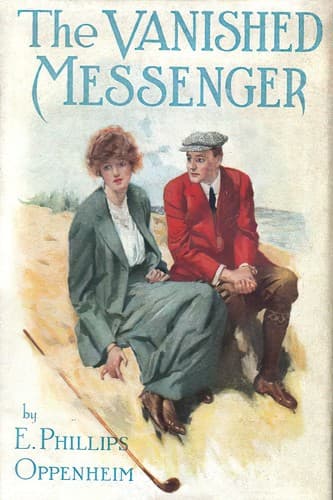
The Vanished MessengerOppenheim, E. Phillips (Edward Phillips)
General
The Vanished Messenger
Oppenheim, E. Phillips (Edward Phillips)
Detective and mystery stories; Fiction
Meekins, with ponderous footsteps, left the room and closed the door
behind him. Mr. Fentolin leaned a little forward in his chair. It
seemed as though he were on springs. The fingers of his right hand
had disappeared in the pocket of his black velvet dinner-coat. He was
certainly prepared for all emergencies.
“Now, Mr. Dunster,” he said softly, “you can speak to me without
reserve.”
Mr. Dunster dropped his voice. His tone became one of fierce eagerness.
“Look here,” he exclaimed, “I don’t think you ought to force me to give
myself away like this, but, after all, you are an Englishman, with a
stake in your country, and I presume you don’t want her to take a
back seat for the next few generations. Listen here. It’s to save your
country that I want to get to The Hague without a second’s delay. I tell
you that if I don’t get there, if the message I convey doesn’t reach
its destination, you may find an agreement signed between certain Powers
which will mean the greatest diplomatic humiliation which Great Britain
has ever known. Aye, and more than that!” Mr. Dunster continued. “It
may be that the bogey you’ve been setting before yourself for all
these years may trot out into life, and you may find St. David’s Hall a
barrack for German soldiers before many months have passed.”
Mr. Fentolin shook his head in gentle disbelief.
“You are speaking to one,” he declared, “who knows more of the political
situation than you imagine. In my younger days I was in the Foreign
Office. Since my unfortunate accident I have preserved the keenest
interest in politics. I tell you frankly that I do not believe you. As
the Powers are grouped at present, I do not believe in the possibility
of a successful invasion of this country.”
“Perhaps not,” Mr. Dunster replied eagerly, “but the grouping of the
Powers as it has existed during the last few years is on the eve of a
great change. I cannot take you wholly into my confidence. I can only
give you my word of honour as a friend to your country that the message
I carry is her only salvation. Having told you as much as that, I do
not think I am asking too much if I ask you for my clothes and
dressing-case, and for the fastest motor-car you can furnish me with.
I guess I can get from here to Yarmouth, and from there I can charter
something which will take me to the other side.”
Mr. Fentolin raised the little gold whistle to his lips and blew it very
softly. Meekins at once entered, closing the door behind him. He moved
silently to the side of the man who had risen now from the bed, and who
was standing with his hand grasping the post and his eyes fixed upon Mr.
Fentolin, as though awaiting his answer.
“Our conversation,” the latter said calmly, “has reached a point, Mr.
Dunster, at which I think we may leave it for the moment. You have
told me some very surprising things. I perceive that you are a more
interesting visitor even than I had thought.”
Public-domain text, read in full here on John Shaqi.
Reviews
Reviews
No reviews yet
Be the first to share your thoughts on this work.
Elsewhere in the archive
Join the Discussion
Join the discussion
Sign in to leave a comment or review.
Sign InorCreate an account