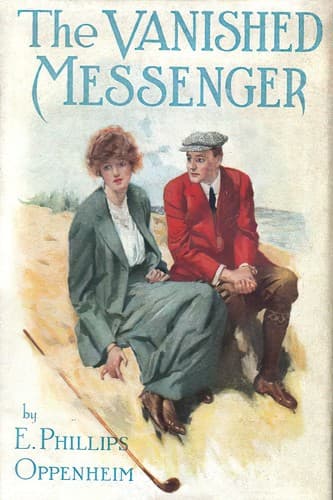
The Vanished MessengerOppenheim, E. Phillips (Edward Phillips)
General
The Vanished Messenger
Oppenheim, E. Phillips (Edward Phillips)
Detective and mystery stories; Fiction
“You’re an obstinate man, Mr. Hamel,” he sighed, “but I suppose you must
have your own way. By-the-by, you would only need to use the up-stairs
room and the sitting-room. You will not need the outhouse--rather more
than an outhouse, though isn’t it? I mean the shed which leads out from
the kitchen, where the lifeboat used to be kept?”
“I don’t think I shall need that,” Hamel admitted, a little
hesitatingly.
“To tell you the truth,” Mr. Fentolin continued, “among my other hobbies
I have done a little inventing. I work sometimes at a model there. It is
foolish, perhaps, but I wish no one to see it. Do you mind if I keep the
keys of the place?”
“Not in the least,” Hamel replied. “Tell me, what direction do your
inventions take, Mr. Fentolin?”
“Before you go,” Mr. Fentolin promised, “I will show you my little model
at work. Until then we will not talk of it. Now come, be frank with me.
Shall we exchange ideas for a little time? Will you talk of books? They
are my daily friends. I have thousands of them, beloved companions on
every side. Or will you talk of politics or travel? Or would you
rather be frivolous with my niece and nephew? That, I think, is Esther
playing.”
“To be quite frank,” Hamel declared bluntly, “I should like to talk to
your niece.”
Mr. Fentolin smiled as though amused. His amusement, however, was
perfectly good-natured.
“If you will open this door,” he said, “you will see another one exactly
opposite to you. That is the drawing-room. You will find Esther there.
Before you go, will you pass me the Quarterly Review? Thank you.”
Hamel crossed the hall, opened the door of the room to which he had been
directed, and made his way towards the piano. Esther was there, playing
softly to herself with eyes half closed. He came and stood by her side,
and she stopped abruptly. Her eyes questioned him. Then her fingers
stole once more over the keys, more softly still.
“I have just left your uncle,” Hamel said. “He told me that I might come
in here.”
“Yes?” she murmured.
“He was very hospitable,” Hamel continued. “He wanted me to remain here
as a guest and not go to the Tower at all.”
“And you?”
“I am going to the Tower,” he said. “I am going there to-morrow or the
day after.”
The music swelled beneath her fingers.
“For how long?”
“For a week or so. I am just giving your uncle time to clear out his
belongings. I am leaving him the outhouse.”
“He asked you to leave him that?” she whispered.
“Yes!”
“You are not going in there at all?”
“Not at all.”
Again she played a little more loudly for a few moments. Then the music
died away once more.
“What reason did he give for keeping possession of that?”
“Another hobby,” Hamel replied. “He is an inventor, it seems. He has the
model of something there; he would not tell me what.”
She shivered a little, and her music drifted away. She bent over the
keys, her face hidden from him.
Public-domain text, read in full here on John Shaqi.
Reviews
Reviews
No reviews yet
Be the first to share your thoughts on this work.
Elsewhere in the archive
Join the Discussion
Join the discussion
Sign in to leave a comment or review.
Sign InorCreate an account