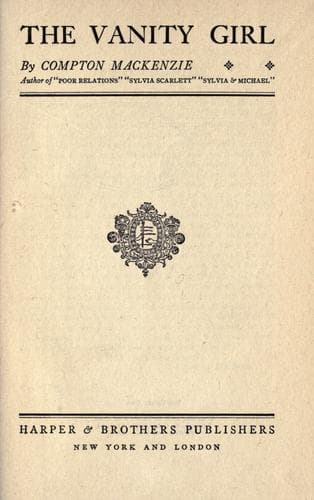
England -- Social life and customs -- 20th century -- Fiction; Social classes -- England -- Fiction
Dorothy's dread that she and Lord Clarehaven might not find themselves
in the same canoe was soon dispelled, because Lord Clarehaven was
evidently as eager for her company as she was for his, and they were
soon leaving the others behind. There is no form of conveyance which
makes for so much intimacy of regard as a canoe, and Dorothy, when she
had once been able to reassure herself by means of a pocket-mirror that
she had not been ruffled by the cab-drive or by the nervous business of
getting gracefully into a wabbling canoe, settled herself down to be
admired at a distance of about four feet. Moreover, she indulged for the
first time in her life in the pleasure of admiring somebody else, a
state of mind which doubled her charm by taking away much of her
self-consciousness. If Lord Clarehaven was below the standard of
aristocracy set by our full-blooded lady novelists, he was equally far
removed from the chinless convention of banal caricature. He had the
long legs, the narrow hips and head, and the big teeth of the Norman;
but his fair hair was already thinning upon a high, retreating forehead,
his nose was small, and if the protuberant eyes that one sees in
Pekinese spaniels and other well-bred mammals were a faint intimation of
approaching degeneracy in the stock, Dorothy was not sufficiently versed
in physiognomy to recognize such symptoms; already fascinated by his
title and his trousers, she was quite ready to be fascinated by his
eyes.
"I was lunching in St. Mary's yesterday with Arthur Lonsdale," he was
explaining, "and I noticed you from the lodge. I should have come up and
spoken to you myself, but I was rather frightened by your friend's
eye-glass. In fact, I'm still not at all at ease with her. She looks
deuced clever, I mean, don't you think?"
"She is awfully clever."
"Poor girl, but I suppose it's not such a bore for a girl as it would
be for a man. I'm an awful ass myself, you know. I mean, I'm absolutely
incapable of doing anything."
"How did you know we belonged to the company?" asked Dorothy, implying
that with all his modesty he must possess acute powers of judgment
hidden away somewhere.
"Well, to tell you the truth, we didn't know. Somebody said your friend
was a medical student, only I wasn't going to have that, and some man
said he'd noticed you at the station, so Lonnie and I went to the
theater on the off-chance and tried to spot you."
"Which you did?"
"Oh, rather. Only, then we couldn't spot your name. I was all for
Clarice Beauchamp."
"She's an awfully horrid girl," said Dorothy, quickly.
"Is she? I'm sorry to hear that. And Lonnie betted you were Fay Onslow.
So we were quits. Funny thing you should have the same name as Lonnie.
No relation, I suppose?"
He was evidently so sure of this that Dorothy was rather piqued and
asked, loftily, which Lonsdale he was.
"Cleveden's son."
"Oh, then I am a relation," said Dorothy. "Though of course a very, very
distant one."
"By Jove! that's great!" said Clarehaven.
Public-domain text, read in full here on John Shaqi.
Reviews
Reviews
No reviews yet
Be the first to share your thoughts on this work.
Elsewhere in the archive
Join the Discussion
Join the discussion
Sign in to leave a comment or review.
Sign InorCreate an account