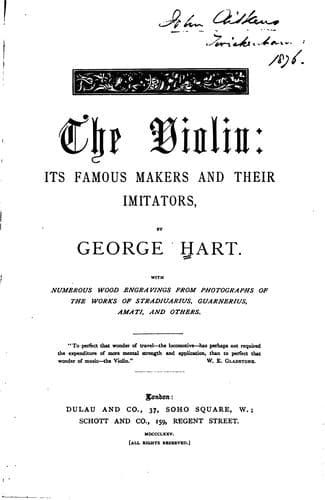
The Violin: Its Famous Makers and Their ImitatorsHart, George
History
The Violin: Its Famous Makers and Their Imitators
Hart, George
Violin -- History; Violin makers -- Biography
There does not exist certain evidence as to the date of the birth and
death of Antonio Amati. We have information of the dates on which his
brother Girolamo died in extracts from parish registers; also the date
of his marriages, which took place in the year 1576, and on May 24,
1584. By his second wife, Girolamo had a family of nine children; the
fifth child was Niccolo, who became the famous Violin-maker. The
mother of Niccolo died of the plague on October 27, 1630, and her
husband, Girolamo, died of the same disease six days later, viz.,
November 2, 1630, and was buried on the same day. Girolamo is
described in the register as "Misser Hieronimo Amati detto il leutaro
della vic di S. Faustino" (viz., maker to the Church). Vincenzo
Lancetti states that "Count Cozio kept a register of all the
instruments seen by him, from which it appeared that the earliest
reliable date of the brothers Amati is 1577, and that they worked
together until 1628; that Antonio survived Jerome and made instruments
until after the year 1648--a fine Violin bearing the last-named date
having been recently seen with the name of Antonio alone." This
information serves in some measure to set at rest much of the
uncertainty relative to the period when these makers lived. These
skilful makers produced some of the most charming specimens of
artistic work. To them we are indebted for the first form of the
instrument known as "Amatese." The early efforts of the brothers Amati
have many of the characteristics belonging to the work of their father
Andrea; their sound-hole is similar to his, and in keeping with the
Brescian form, and the model which they at first adopted is higher
than that of their later and better instruments.
Although these makers placed their joint names in their Violins, it
must not be supposed that each bore a proportionate part of the
manufacture in every case; on the contrary, there are but few
instances where such association is made manifest. The style of each
was distinct, and one was immeasurably superior to the other. Antonio
deviated but little from the teaching of his father. The sound-holes
even of his latest instruments partake of the Brescian type, and the
model is the only particular in which it may be said that a step in
advance is traceable; here he wisely adopted a flatter form. His work
throughout, as regards finish, is excellent.
Public-domain text, read in full here on John Shaqi.
Reviews
Reviews
No reviews yet
Be the first to share your thoughts on this work.
Join the Discussion
Join the discussion
Sign in to leave a comment or review.
Sign InorCreate an account