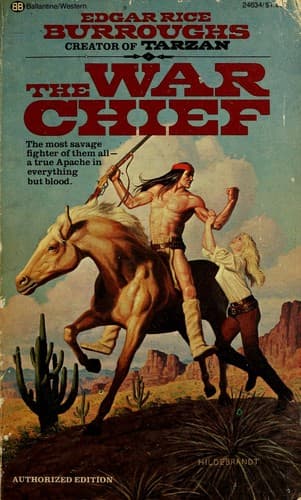
Apache Indians -- Fiction; Historical fiction; Western stories
One morning Shoz-Dijiji did not come to school. He never came again. His
teacher made diligent inquiry which always ended against the dead wall
of an Indian, “No savvy.” She did not connect Black Bear’s disappearance
with the release of Geronimo from the guardhouse the previous afternoon,
because she did not know that Black Bear was Geronimo’s son.
She knew nothing about Black Bear. From her he had learned all that he
sought to learn; from him she had learned nothing; for which there is
just one good and sufficient reason—Black Bear was an Apache. Of all
the great Indian tribes that have roamed North America none has been in
contact with white men longer than the Apache, and of none is there less
known.
Ugly, morose, vengeful, Geronimo came back to his people, and that same
night they slipped away toward the south. Every member of the tribe was
mounted and their meager belongings, their store of provisions, were
packed upon the backs of spare ponies.
Shoz-Dijiji was happy. The three months spent at San Carlos under the
petty restrictions of a semi-military regime had seemed an eternity of
bondage to his free, wild nature. Now again he could breathe, out in the
open where there were no fences, no walls, as far as the eye could
reach, and the air was untainted by the odor of white men.
He looked up at the moon-silvered mountains and out across the dim,
mysterious distance of the plain. He heard the old, familiar voices of
the night, and her perfumes were sweet in his nostrils. He drank deep of
it, filling his lungs. He wanted to leap into the air and dance and
shout; but he only sat stolidly astride his pony, his face reflecting
nothing of all that filled his heart.
Travelling by night, hiding by day, Geronimo led his people to a hidden
valley, deep in the mountains, far from the trails and settlements of
the pindah lickoyee. There they lived in peace and security for a long
time, making occasional journeys into Mexico to trade, or to neighboring
Indian tribes for the same purpose.
Shoz-Dijiji grew taller, stronger. Few warriors of the Be-don-ko-he
could hurl a lance as far as he, and none could send an arrow with
greater accuracy to its goal; he could out-run and out-jump them all,
and his horsemanship brought a gleam of pride to the cruel, blue eyes of
Geronimo.
The long period of peace broke down the discipline of the tribe and even
astute old Geronimo nodded. An individualist in the extreme sense of the
word, an Apache takes orders from no one except as it suits him to do
so. Their chiefs are counsellors; they may not command. Only the war
chiefs in time of battle or upon the war trail are vouchsafed anything
approaching absolute authority. It is the ambition of every youth to
become a warrior so that he may do whatever he wishes to do, without let
or hindrance.
Public-domain text, read in full here on John Shaqi.
Reviews
Reviews
No reviews yet
Be the first to share your thoughts on this work.
Join the Discussion
Join the discussion
Sign in to leave a comment or review.
Sign InorCreate an account