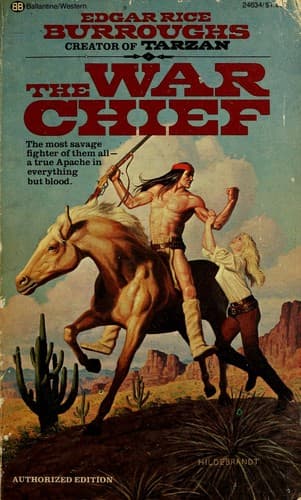
Apache Indians -- Fiction; Historical fiction; Western stories
Throw yourself prone beside this savage sentinel and follow his gaze
along the back trail. Your eyes just top the summit of a ridge which
hides your body from an enemy approaching from the south. A small bush,
from which you have broken a few branches that you may have an
unobstructed field of vision, masks that portion of your head that rises
above the ridge. An enemy might approach you up the southern slope of
the ridge to within a few feet of the concealing bush and not detect
your presence.
Just below, to the south, is a tiny meadow, its grasses sere and yellow;
for the rains passed months ago. Beneath a single tree at the upper end
of the meadow is a mud hole where Shoz-Dijiji, having filled the water
bottles, is letting the ponies drink. Farther on the canyon widens where
it debouches on a rolling plain that stretches on and on to hazy
mountains in the south. There are mountains to the west, too; and close
at hand, in the east, rise the more imposing Sierra Madre.
The plain shimmers in the heat that is still intense, though the sun is
low. The sage and the greasewood point long, shadowy fingers toward the
Mother of Mountains. Nowhere in all that vast expanse that your eye can
see is there a sign of life. You might be looking; upon a dead world or
a painted canvas. The slow lengthening of the shadows is imperceptible.
You see nothing that might even remotely suggest life, beyond the
solitary brave watering the ponies below you; but that is because the
asthenia of civilization has left you half blind as well as half deaf,
for where you see nothing and hear nothing Geronimo is conscious of
life, movement and sound—of rodents, reptiles and birds awaiting,
quiescent, the lessening heat of dusk.
Of these things he is merely conscious, his attention being centered
upon some tiny specks moving in the haze of the distant horizon. These
you could not see if they were pointed out, much less recognize; but
Geronimo has been watching them for some time. He has recognized them,
counted them. He half turned toward his companion who was freshening the
paint upon his face.
“The vaqueros are coming after their ponies,” he said. “There are nine
of them.”
The other crawled to his side and looked. “They will camp here tonight,”
he said. “It is the first water.”
Geronimo nodded and grunted some brief instructions. The warrior made
his way leisurely down to the water hole, which Shoz-Dijiji had now
left. Arrived at his destination he proceeded to carry out the
instructions of his chief, muddying the water hole and then befouling it
beyond use by man or beast. Disgusting? Hideous? Cruel? Do not forget
that he was on the war trail. Do not forget that he was only a savage,
primitive Apache Indian. Make allowances for him. Had he had the
cultural advantages of the gorgeous generals of civilization he might
have found the means to unloose a poison gas that would have destroyed
half the population of Sonora.
Public-domain text, read in full here on John Shaqi.
Reviews
Reviews
No reviews yet
Be the first to share your thoughts on this work.
Elsewhere in the archive
Join the Discussion
Join the discussion
Sign in to leave a comment or review.
Sign InorCreate an account