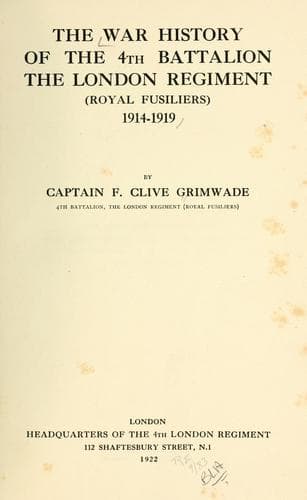
The War History of the 4th Battalion, the London Regiment (Royal Fusiliers), 1914-1919Grimwade, F. Clive
History
The War History of the 4th Battalion, the London Regiment (Royal Fusiliers), 1914-1919
Grimwade, F. Clive
Great Britain. Army. London Regiment. 4th (City of London) Battalion; World War, 1914-1918 -- Regimental histories -- Great Britain
The weather had now definitely broken and heavy rains fell, reducing
the trenches to veritable seas of mud. The Battalion continued to
occupy the Keeps until the evening of the 30th, the duty having passed
quietly with the exception of a small amount of enemy shell fire; but a
large proportion of the shells being "blind" no casualties were caused.
On relief on the 30th the 1/4th Londons once more withdrew to Lansdowne
Post. On the 2nd October the Ferozepore Brigade was relieved by the
19th Division and moved out to billets in the La Gorgue-Riez Bailleul
area. Here it remained resting and training for a week, throughout
which the weather remained vile in the extreme.
On the 11th October the Ferozepore Brigade once more took over the
Neuve Chapelle sector from the Jullundur, the 1/4th Londons occupying
the right subsector with a detachment of the 89th Punjabis[2] in Hills
Redoubt and Battalion Headquarters in Sandbag Alley. On the left of the
1/4th Londons the Brigade sector was taken up as far as Château Road by
the 57th Rifles while the Connaughts were on the extreme left as far as
Sunken Road.
[2] The 89th Punjabis reached France in June and replaced the 9th
Bhopals in the Ferozepore Brigade.
Two days later the Ferozepore Brigade conducted a second feint attack
in conjunction with other operations which it is not necessary to
detail. On this occasion the feint was timed to take place shortly
after midday, the morning being occupied by our guns in a systematic
wire-cutting shoot, which was followed by a heavy bombardment of the
enemy trenches during the projection of the smoke screen. Following
the smoke screen, smoke barrages were formed on the flanks of the
feint attack at 1.45 p.m., and simultaneously with them the infantry
in the line operated with rifle fire and demonstrations similar to
those employed on the former occasion to give the illusion of a
pending attack. The wind again was unfavourable, this time blowing
the smoke along No Man's Land between the lines instead of over the
enemy's trenches; and owing to the strength of the wind the smoke
screen never became dense enough to conceal the bomb guns by which it
was delivered. During the whole period of the operation our front and
rear lines were subjected to a heavy fire from the enemy's artillery,
which caused very great damage to our breastworks and wire, guns as
heavy as 8-inch being employed with great intensity between 12.45 and
1.30 p.m. This bombardment caused large numbers of casualties in the
1/4th Londons, it being impossible to clear, even temporarily, the
bombarded trenches owing to the necessity of maintaining as intensely
as possible the bursts of rifle fire in accordance with the scheme.
It is a matter of grave doubt as to whether these demonstrations were
worth the casualties they cost; and it seems abundantly evident that no
useful purpose can have been served by carrying through a prearranged
scheme essentially dependent on the weather when the conditions on
Public-domain text, read in full here on John Shaqi.
Reviews
Reviews
No reviews yet
Be the first to share your thoughts on this work.
Elsewhere in the archive
Join the Discussion
Join the discussion
Sign in to leave a comment or review.
Sign InorCreate an account