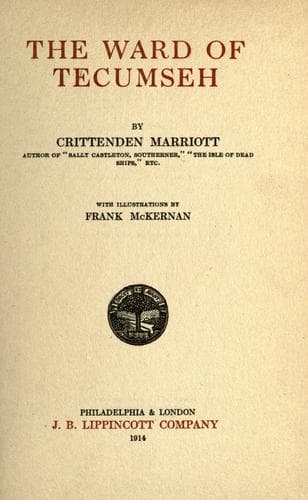
Indians of North America -- Wars -- 1812-1815 -- Fiction; United States -- History -- War of 1812 -- Fiction
A moment more and the man had come up. “Ah! Is it my good friend, Major
Stickney?” he burst out. “He brings me the guests, yes!”
Stickney nodded, smilingly. “Four of them, Peter,” he said; “and one
more to come--a very special one. I commend him especially to your
sister. A man named--er--Rogers, I believe.” He grinned at the woman,
who was hurrying up.
She grinned back at him. “Oh! La! La!” she cried. “That silent Mr.
Rogers. He will not talk. He will do nothing but eat. Mon Dieu! What is
one to do with such a man? But les autres! These other messieurs here.
They are most welcome.”
Stickney nodded. “They start for Detroit tomorrow,” he explained,
“but before they go they want to eat some of your so-wonderful meals.
They’ve heard about them from Rogers. Ah! But that man adores you,
Madame Fantine. Besides, they’ve got a lot to ask you.”
“To ask me, monsieur?” The French woman’s beady eyes darted inquiringly
from Stickney to Jack and back again.
“Yes! You and our good friend Pierre.”
“Bon! I shall answer with a gladness, but, yes, with a gladness. It
is of the most welcome that they are. They are of the nobility. With
half an eye one can see that. It will be a pleasure the most great to
entertain them.”
As she spoke the French woman’s roving eyes rested on Alagwa’s face.
Instantly they widened with an amazement that sent the blood flooding
to the tips of the girl’s shell-like ears. Then they jumped to Jack’s
face and she gasped.
“Of a truth, monsieur,” she went on, after an almost imperceptible
break. “It is not worth the while to prepare the dishes of la belle
France for the cochons who live hereabouts. They care for naught but
enough to fill their bellies! But you, monsieur, ah! it will be the
great pleasure to cook for you. Entrez! Entrez! Messieurs.” She stood
aside and waved her guests toward the house.
CHAPTER XII
THE “Maison Bondie” consisted of two square buildings of the blockhouse
type, set thirty or forty feet apart and connected by a single roof
that turned the intervening space into a commodious shed, beneath which
was a well and a rack with half a dozen basins that plainly comprised
the toilet arrangements of the hotel. Both buildings were built of
logs, roughly squared and strongly notched together at the corners. The
doorways, which opened on the covered space, were small, and the doors
themselves were massive. The windows were few and were provided with
stout inside shutters that could be swung into place and fastened at a
moment’s notice. Loopholes were so placed as to command all sides of
the building. The place looked as if built to withstand an attack, and,
in fact, had withstood more than one in its ten-years’ history.
Back of the buildings were half a dozen wagons, each fronted by a pair
of horses or mules, which were contentedly munching corn from the heavy
troughs that had been removed from the rear and placed athwart the
tongue of the wagon.
Public-domain text, read in full here on John Shaqi.
Reviews
Reviews
No reviews yet
Be the first to share your thoughts on this work.
Elsewhere in the archive
Join the Discussion
Join the discussion
Sign in to leave a comment or review.
Sign InorCreate an account