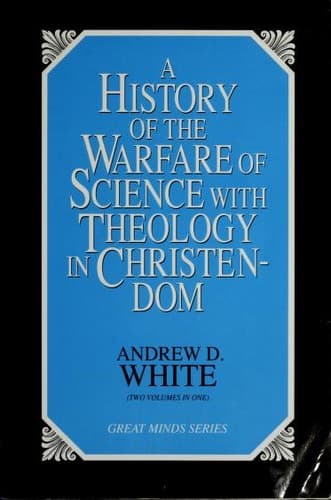
Religion and science; Religion and science -- History; Science -- History
May we not, then, hope that the greatest and best men in the
Church--the men standing at centres of thought--will insist with
power, more and more, that religion be no longer tied to so injurious
a policy as that which this warfare reveals; that searchers for truth,
whether in theology or natural science, work on as friends, sure that,
no matter how much at variance they may at times seem to be, the
truths they reach shall finally be fused into each other? The dominant
religious conceptions of the world will doubtless be greatly modified
by science in the future, as they have been in the past; and the part
of any wisely religious person, at any centre of influence, is to see
that, in his generation, this readjustment of religion to science be
made as quietly and speedily as possible.
No one needs fear the result. No matter whether Science shall
complete her demonstration that man has been on the earth not merely
six thousand years, or six millions of years; no matter whether she
reveals new ideas of the Creator or startling relations between his
creatures; no matter how many more gyves and clamps upon the spirit of
Christianity she destroys: the result, when fully thought out, will
serve and strengthen religion not less than science.[160]
What science can do for the world is shown, not by those who have
labored to concoct palatable mixtures of theology and science--men like
Cosmas, and Torrubia, and Burnet, and Whiston--but by men who have
fought the good fight of faith in truth for truth's sake--men like
Roger Bacon, and Vesalius, and Palissy, and Galileo.
What Christianity can do for the world is shown, not by men who have
stood on the high places screaming in wrath at the advance of science;
not by men who have retreated in terror into the sacred caves and
refused to look out upon the universe as it is; but by men who have
preached and practised the righteousness of the prophets, and the
aspirations of the Psalmist, and the blessed Sermon on the Mount, and
"the first great commandment, and the second which is like unto it,"
and St. James's definition of "pure religion and undefiled."
It is shown in the Roman Church, not by Tostatus and Bellarmin, but
by St. Carlo Borromeo, and St. Vincent de Paul, and Fénelon, and
Eugénie de Guérin; in the Anglican Church, not by Dean Cockburn, but
by Howard, and Jenner, and Wilberforce, and Florence Nightingale; in
the German Church, not by Pastor Knak, but by Pastor Fliedner; in the
American Church, not by the Mathers, but by such as Bishop Whatcoat,
and Channing, and Muhlenberg, and Father De Smet, and Samuel May, and
Harriet Stowe.
Public-domain text, read in full here on John Shaqi.
Reviews
Reviews
No reviews yet
Be the first to share your thoughts on this work.
Elsewhere in the archive
Join the Discussion
Join the discussion
Sign in to leave a comment or review.
Sign InorCreate an account