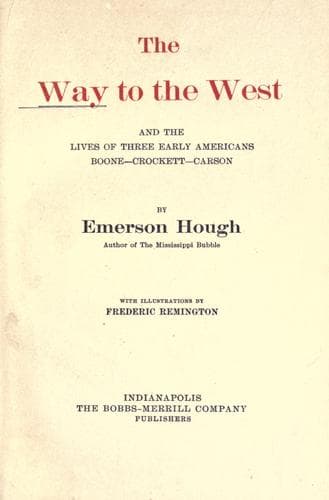
The Way to the West, and the Lives of Three Early Americans: Boone—Crockett—CarsonHough, Emerson
History
The Way to the West, and the Lives of Three Early Americans: Boone—Crockett—Carson
Hough, Emerson
Boone, Daniel, 1734-1820; Carson Kit, 1809-1868; Crockett, Davy, 1786-1836; Mississippi River Valley -- History; West (U.S.) -- History
As to that war-like breed, the Scotch-Irish, famous in American
frontiering, the same historian first quoted goes on in detailed
description from which we may take the following:
“History has touched lightly upon the home life of the little colony of
Ulster Scots, who settled on the banks of the Neshaminy in the townships
of Warwick, Warrington and New Britain, in Bucks County, Pa.; but these
people were none the less worthy of a prominent place in the records of
the past. Driven by religious persecution from their native Highlands in
the seventeenth century, the remnants of many a noble clan sought
temporary refuge in the province of Ulster, Ireland, whence, between the
years 1720 and 1740, thousands of them migrated to America, and peopled
the hills and valleys of Pennsylvania’s frontier with a sturdy, rugged
race that was destined to play an important part in the formation of our
national character.
“Clannish by nature and tradition, they clung together in small
communities of two score or more families, a majority of them related by
ties of blood or marriage. They took up the unsettled portions of the
new province. Accustomed for generations to the rugged mountain sides of
their own native land, the roughness of the new territory did not
discourage them. In fact, the steep hillsides on the banks of our rivers
and smaller streams, shunned or neglected by the early English settlers,
seem to have had an especial attraction for them.
“Possessed of a character as stern and uncompromising as the granite of
their native mountains, this little colony did not concern itself in the
affairs of its neighbors. Indeed there was no occasion to do so. They
had brought with them the things they needed, and had inherent in their
nature that which made them a people separate and apart from the
communities by which they were surrounded. In their lives and characters
was a declaration of independence that in itself nourished the spirit of
freedom, which was to carry these people into the thick of the fight
when the time arrived to bid defiance to the mother country.
“This spirit was further augmented by their independence and resources
in the development of the material affairs of the colony. As previously
stated, there were among the first settlers men of every trade and
calling calculated to make the colony self-sustaining. There were
husbandmen, weavers, smiths, masons, joiners, cord-wainers, millers and
tradesmen, whose industry and thrift made it possible for the
schoolmaster and preacher to devote himself exclusively to the
intellectual and spiritual needs of the community. But with true Scotch
economy, the teacher and preacher were often one and the same. As an
illustration may be cited the founding of Tennent’s famous Log College
as an adjunct to the Neshaminy Church, of which he was pastor.
Public-domain text, read in full here on John Shaqi.
Reviews
Reviews
No reviews yet
Be the first to share your thoughts on this work.
Join the Discussion
Join the discussion
Sign in to leave a comment or review.
Sign InorCreate an account