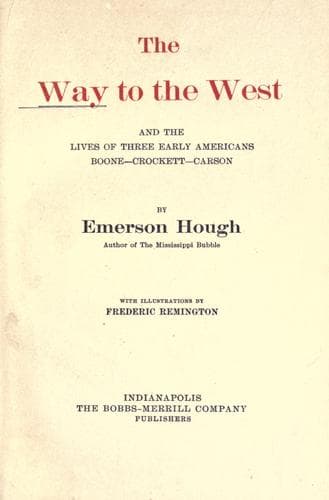
The Way to the West, and the Lives of Three Early Americans: Boone—Crockett—CarsonHough, Emerson
History
The Way to the West, and the Lives of Three Early Americans: Boone—Crockett—Carson
Hough, Emerson
Boone, Daniel, 1734-1820; Carson Kit, 1809-1868; Crockett, Davy, 1786-1836; Mississippi River Valley -- History; West (U.S.) -- History
As to personal description, Boone was neither a tall nor a thin man. He
was not angular nor bony. His frame was covered not with cloying fat but
with firm and easily playing muscles, and he carried none of the useless
tissue of the man of civilization. His weight was “about one hundred and
seventy-five pounds.” Audubon, who met him late in his life, says: “He
approached the gigantic in stature. His chest was broad and prominent,
and his muscular powers were visible in every limb. His countenance gave
indication of his great courage, enterprise and perseverance.”
Yet in person Boone did not quite reach the six-foot mark, but was just
below five feet and ten inches in stature, some say five feet eight
inches, being therefore of exactly that build which good judges of men
esteem to be most desirable for combined strength, activity and
endurance. He was rather broad shouldered: that is to say, his shoulders
nicely overhung his hips. All agree that he was of “robust and powerful
proportions.” One historian speaks of his “piercing hazel eye”; yet this
is but romancing.
Most portraits of Daniel Boone are the products of imagination. The most
authentic, perhaps the only authentic portrait of him, is that painted
in 1820 by Chester Harding, “who,” says an early writer, “of American
artists is the one most celebrated for his likenesses.” When Harding
made his portrait of Boone, the latter was very feeble, and had to be
supported during the sittings. This portrait shows a face thin and pale,
with hair of snowy whiteness and eye “bright blue, mild and pleasant.”
This blue eye is of the best color in all the world for keenness of
vision, for quickness and accuracy with the rifle. The Harding portrait
does not show the square chin that some writers give to Boone; and
certainly it portrays no ferocious looking ruffian, but a man mild,
gentle and contemplative, “not frivolous, thoughtless or agitated.”
As to Boone’s appearance early in life, we must to some extent join the
others who imagine or presume. It is fair to suppose that in complexion
he was florid, with the clear skin, sometimes marked with freckles, that
you may see to-day in the mountains of the Cumberland, in parts of
Tennessee, Kentucky, sometimes in North Carolina and Mississippi. The
color of his hair was never that of “raven blackness.” Perhaps it was
brown, but not a finely filamented brown. It was more likely blond, and
perhaps indeed carried a shade of red. Certainly the ends of his hair
were bleached a tawny yellow, that splendid yellow that you may see even
to-day in the hair and beard and mustaches of the outdoor men of the
American West.
In his younger days he often wore the half savage garb of the early
American hunters—the buckskin or linsey hunting shirt, the fringed
leggings of the same material, with moccasins made of the skin of the
deer or buffalo. His hat was as chance would have it. Perhaps sometimes
he wore a cap of fur.
Public-domain text, read in full here on John Shaqi.
Reviews
Reviews
No reviews yet
Be the first to share your thoughts on this work.
Join the Discussion
Join the discussion
Sign in to leave a comment or review.
Sign InorCreate an account