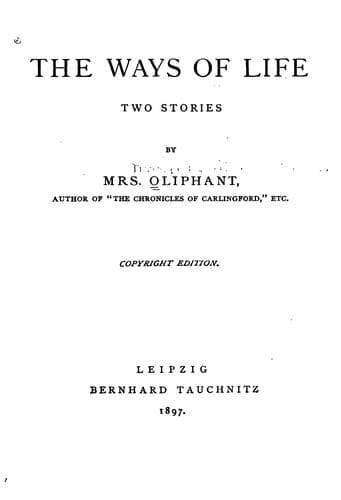
The Ways of Life: Two StoriesOliphant, Mrs. (Margaret)
General
The Ways of Life: Two Stories
Oliphant, Mrs. (Margaret)
Fiction
Light the candles! She could see, where she sat there, the red sunshine
falling in a blaze upon a ruddy heathery hill, and beating upon the dark
firs which stood out like ink against that background. There is perhaps
nothing that so wrings the heart of the watcher as this pathetic mistake
of day for night which betrays the eyes from which all light is
failing. He lay within the shadow of the curtain, always holding her
hand fast, and fell asleep--a sleep which, for a time, was soft and
quiet enough, but afterwards got a little disturbed. She sat quite
still, not moving, scarcely breathing, that she might not disturb him;
not a tear in her eye, her whole being wound up into an external calm
which was so strangely unlike the tumult within. And she had forsaken
him--left him to meet calamity without her support, without sympathy or
aid! She had been immersed in the pleasures of the children, their
expeditions, their amusements. She remembered, with a shudder, that it
had been a little relief to get him away, to have their dance
undisturbed. Their dance! Her heart swelled as if it would burst. She
had been his faithful wife since she was little more than a child. All
her life was his--she had no thought, no wish, apart from him. And yet
she had left him to bear this worst of evils alone!
Mrs. Sandford dared not break the sacred calm by a sob or a sigh. She
dared not even let the tears come to her eyes, lest he should wake and
be troubled by the sight of them. What thoughts went through her mind as
she sat there, not moving! Her past life all over, which, until that
telegram came, had seemed the easy tenor of every day; and the future,
so dark, so awful, so unknown--a world which she did not understand
without him.
After an interval he began to speak again, but so that she saw he was
either asleep still or wandering in those vague regions between
consciousness and nothingness. “All against the wall--with the faces
turned,” he said. “Three--all the last ones: the one my wife liked so.
In the inner room: Daniells is a good fellow. He spared me the sight of
them outside. Three--that’s one of the perfect numbers--that’s--I could
always see them: on the road and on the moor, and at the races: then--I
wonder--all the way up--on the road to heaven? no, no. One of the
angels--would come and turn them round--turn them round. Nothing like
that in the presence of God. It would be disrespectful--disrespectful.
Turn them round--with their faces----” He paused; his eyes were closed,
an ineffable smile came over his mouth. “He--will see what’s best in
them,” he said.
After this for a time silence reigned, broken only now and then by a
word sometimes unintelligible. Once his wife thought she caught
something about the “four square walls in the new Jerusalem,” sometimes
tender words about herself, but nothing clear. It was not till night
that he woke, surprising them with an outcry as to the light, as he had
previously spoken about the darkness.
Public-domain text, read in full here on John Shaqi.
Reviews
Reviews
No reviews yet
Be the first to share your thoughts on this work.
Elsewhere in the archive
Join the Discussion
Join the discussion
Sign in to leave a comment or review.
Sign InorCreate an account