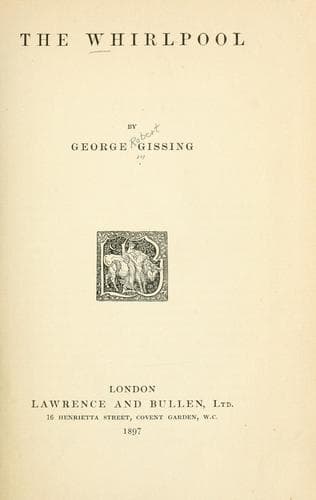
England -- Social life and customs -- 19th century -- Fiction; English fiction -- 19th century
Alma continued to walk along the Nymphenburg road, unconscious of
external things. The tram for which she had been waiting passed by; she
no longer cared to go out into the country. It was enough to keep
moving in the bright sunshine, and to think her thoughts.
No; people had by no means forgotten her. Whilst she was allowing
herself to fall into gloom and indolence, her acquaintances, it was
evident, made her a constant subject of talk, of speculation; just what
she had desired, but had lost courage to believe. They expected great
things of her; her personal popularity and her talents had prevailed
against the most prejudicial circumstance; people did not think of her
as the daughter of Bennet Frothingham,--unless to contrast the
hopefulness of her future with the black calamity that lay behind.
She waxed philosophical. How everything in this world tends to good! At
her father's death she had mourned bitterly; it had struck her to the
heart; his imprudence (she could never use, even in thought, a harsher
word) pained more than it shamed her, and not a day passed but she
sorrowed over the dishonour that darkened his memory. Yet were not
these woes and disasters the beginning of a new life for _her_! In
prosperity, what would she ever have become? Nothing less than being
thrown out into the world could have given her the impulse needed to
realise a high ambition. '_Tant mieux_, another great violinist!' How
sincerely, how inspiringly, it was said!
And Alma's feet had brought her home again before she paused to reflect
that, for all purposes of ambition, the past half-year had been utterly
wasted. Never mind; after her return from Bregenz!
On her table lay Redgrave's note; a very civil line or two, requesting
permission to call. There was another letter, black-bordered, which
came from her step-mother. Mrs. Frothingham said that she had been
about to write for several days, but all sorts of disagreeable business
had hindered her; even now, she could only write hurriedly. In the last
fortnight she had had to go twice to London. 'And really I think I
shall be obliged to go and live there again, for a time; so many things
have to be seen to. It might be best, perhaps, if I took a small flat.
I was going to say, however, that the last time I went up, I met Mr.
Redgrave, and we had quite a long talk--about _you_. He was most
sincerely interested in your future; indeed it quite surprised me, for
I will confess that I had never had a very high opinion of him. I fancy
he suffered _no loss_. His behaviour to me was that of a gentleman,
very different from that of some people I could name. But it was _you_
he spoke of most. He said he was shortly going to Germany, and begged
me to let him have your address, and really I saw no harm in it. He may
call upon you. If so, let me hear all about it, for it will interest me
very much.'
Public-domain text, read in full here on John Shaqi.
Reviews
Reviews
No reviews yet
Be the first to share your thoughts on this work.
Join the Discussion
Join the discussion
Sign in to leave a comment or review.
Sign InorCreate an account