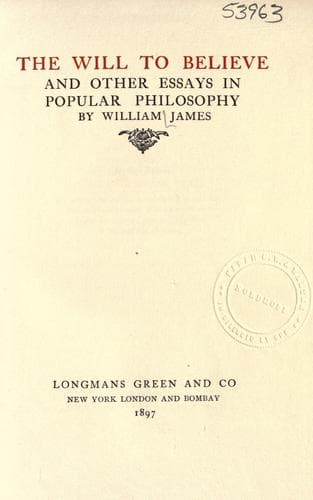
The Will to Believe, and Other Essays in Popular Philosophy — John Shaqi
The Will to Believe, and Other Essays in Popular PhilosophyJames, William
Religion
The Will to Believe, and Other Essays in Popular Philosophy
James, William
Belief and doubt; Essays; Philosophy
your trust or mistrust,--both universes having been only _maybes_, in
this particular, before you contributed your act.
Now, it appears to me that the question whether life is worth living is
subject to conditions logically {60} much like these. It does, indeed,
depend on you _the liver_. If you surrender to the nightmare view and
crown the evil edifice by your own suicide, you have indeed made a
picture totally black. Pessimism, completed by your act, is true
beyond a doubt, so far as your world goes. Your mistrust of life has
removed whatever worth your own enduring existence might have given to
it; and now, throughout the whole sphere of possible influence of that
existence, the mistrust has proved itself to have had divining power.
But suppose, on the other hand, that instead of giving way to the
nightmare view you cling to it that this world is not the _ultimatum_.
Suppose you find yourself a very well-spring, as Wordsworth says, of--
"Zeal, and the virtue to exist by faith
As soldiers live by courage; as, by strength
Of heart, the sailor fights with roaring seas."
Suppose, however thickly evils crowd upon you, that your unconquerable
subjectivity proves to be their match, and that you find a more
wonderful joy than any passive pleasure can bring in trusting ever in
the larger whole. Have you not now made life worth living on these
terms? What sort of a thing would life really be, with your qualities
ready for a tussle with it, if it only brought fair weather and gave
these higher faculties of yours no scope? Please remember that
optimism and pessimism are definitions of the world, and that our own
reactions on the world, small as they are in bulk, are integral parts
of the whole thing, and necessarily help to determine the definition.
They may even be the decisive elements in determining the definition.
A large mass can have its unstable equilibrium overturned by the
addition {61} of a feather's weight; a long phrase may have its sense
reversed by the addition of the three letters _n-o-t_. This life is
worth living, we can say, _since it is what we make it, from the moral
point of view_; and we are determined to make it from that point of
view, so far as we have anything to do with it, a success.
Now, in this description of faiths that verify themselves I have
assumed that our faith in an invisible order is what inspires those
efforts and that patience which make this visible order good for moral
men. Our faith in the seen world's goodness (goodness now meaning
fitness for successful moral and religious life) has verified itself by
leaning on our faith in the unseen world. But will our faith in the
unseen world similarly verify itself? Who knows?
Public-domain text, read in full here on John Shaqi.
Reviews
Reviews
No reviews yet
Be the first to share your thoughts on this work.
Join the Discussion
Join the discussion
Sign in to leave a comment or review.
Sign InorCreate an account