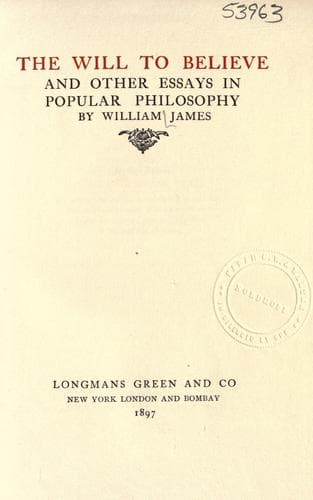
The Will to Believe, and Other Essays in Popular PhilosophyJames, William
Religion
The Will to Believe, and Other Essays in Popular Philosophy
James, William
Belief and doubt; Essays; Philosophy
Once more it is a case of _maybe_; and once more maybes are the essence
of the situation. I confess that I do not see why the very existence
of an invisible world may not in part depend on the personal response
which any one of us may make to the religious appeal. God himself, in
short, may draw vital strength and increase of very being from our
fidelity. For my own part, I do not know what the sweat and blood and
tragedy of this life mean, if they mean anything short of this. If
this life be not a real fight, in which something is eternally gained
for the universe by success, it is no better than a game of private
theatricals from which one may withdraw at will. But it _feels_ like a
real fight,--as if there were something really wild in the universe
which we, with all our idealities and faithfulnesses, are needed to
redeem; and first of all to redeem our own hearts from atheisms and
fears. For such a half-wild, half-saved universe our nature is
adapted. The deepest thing in our {62} nature is this _Binnenleben_
(as a German doctor lately has called it), this dumb region of the
heart in which we dwell alone with our willingnesses and
unwillingnesses, our faiths and fears. As through the cracks and
crannies of caverns those waters exude from the earth's bosom which
then form the fountain-heads of springs, so in these crepuscular depths
of personality the sources of all our outer deeds and decisions take
their rise. Here is our deepest organ of communication with the nature
of things; and compared with these concrete movements of our soul all
abstract statements and scientific arguments--the veto, for example,
which the strict positivist pronounces upon our faith--sound to us like
mere chatterings of the teeth. For here possibilities, not finished
facts, are the realities with which we have actively to deal; and to
quote my friend William Salter, of the Philadelphia Ethical Society,
"as the essence of courage is to stake one's life on a possibility, so
the essence of faith is to believe that the possibility exists."
These, then, are my last words to you: Be not afraid of life. Believe
that life _is_ worth living, and your belief will help create the fact.
The 'scientific proof' that you are right may not be clear before the
day of judgment (or some stage of being which that expression may serve
to symbolize) is reached. But the faithful fighters of this hour, or
the beings that then and there will represent them, may then turn to
the faint-hearted, who here decline to go on, with words like those
with which Henry IV. greeted the tardy Crillon after a great victory
had been gained: "Hang yourself, brave Crillon! we fought at Arques,
and you were not there."
[1] An Address to the Harvard Young Men's Christian Association.
Published in the International Journal of Ethics for October, 1895, and
as a pocket volume by S. B. Weston, Philadelphia, 1896.
Public-domain text, read in full here on John Shaqi.
Reviews
Reviews
No reviews yet
Be the first to share your thoughts on this work.
Join the Discussion
Join the discussion
Sign in to leave a comment or review.
Sign InorCreate an account